
[Chapter 2 Summary] of Linear Algebra
[Chapter 2 Summary] of Linear Algebra
Chapter 2 Matrix Algebra
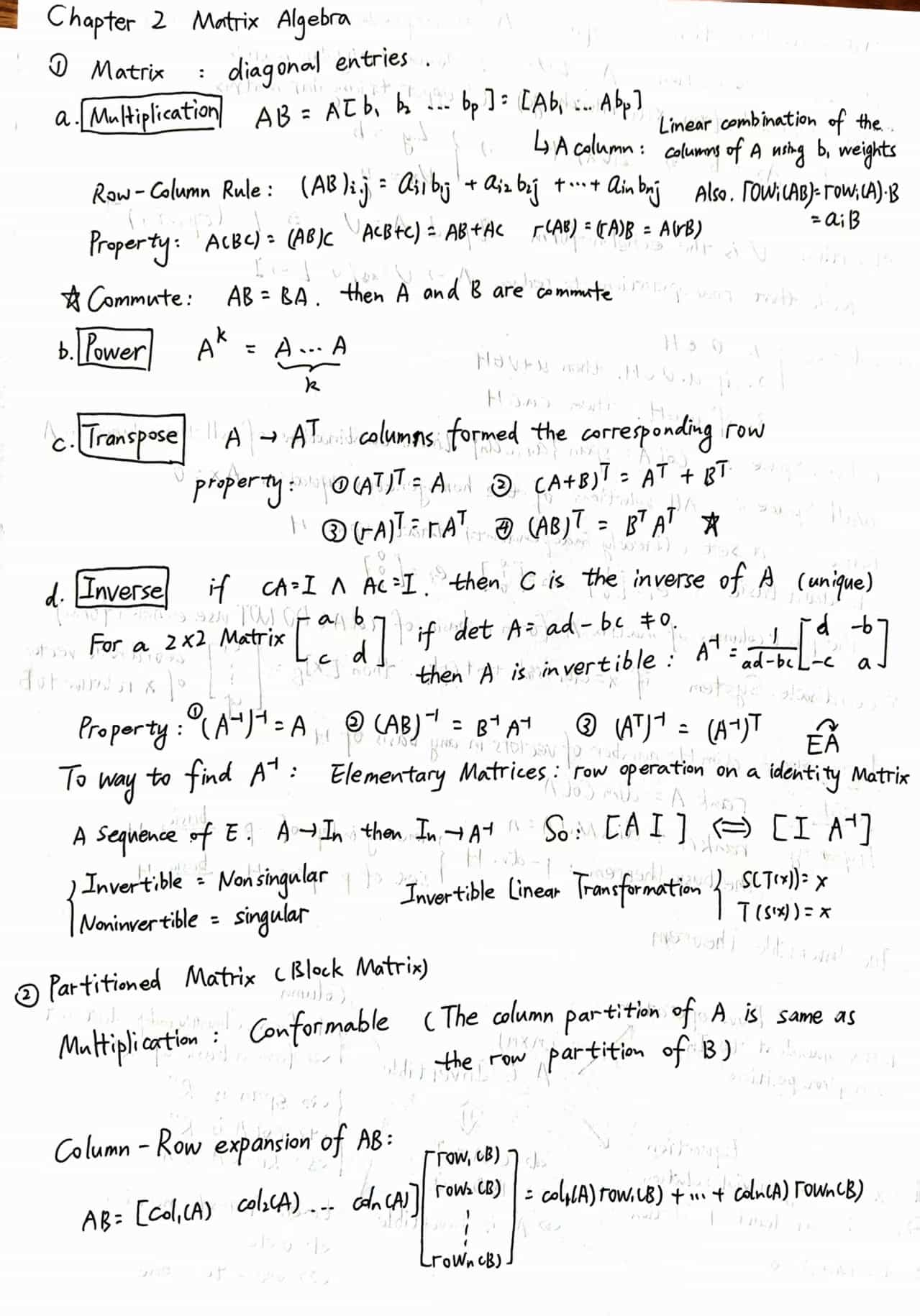
1. Matrix Operations
Diagonal entries
a. Multiplication
- Definition:
- Interpretation: column is a linear combination of the columns of using weights.
- Row-Column Rule:
- Additional Property:
- Algebraic Properties:
- Commutativity: If , then and are said to commute.
b. Power
c. Transpose
- Definition: (Columns formed the corresponding rows)
- Properties:
- (Important)
d. Inverse
- Definition: If and , then is the inverse of (unique).
- For a Matrix:
For , if , then is invertible: - Properties:
- (Important)
- Way to find :
- Elementary Matrices: Row operation on an identity Matrix.
- A sequence of : then . So: .
- Terminology:
- Invertible = Nonsingular
- Noninvertible = Singular
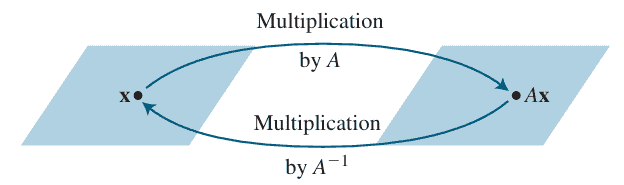
- Invertible Linear Transformation:
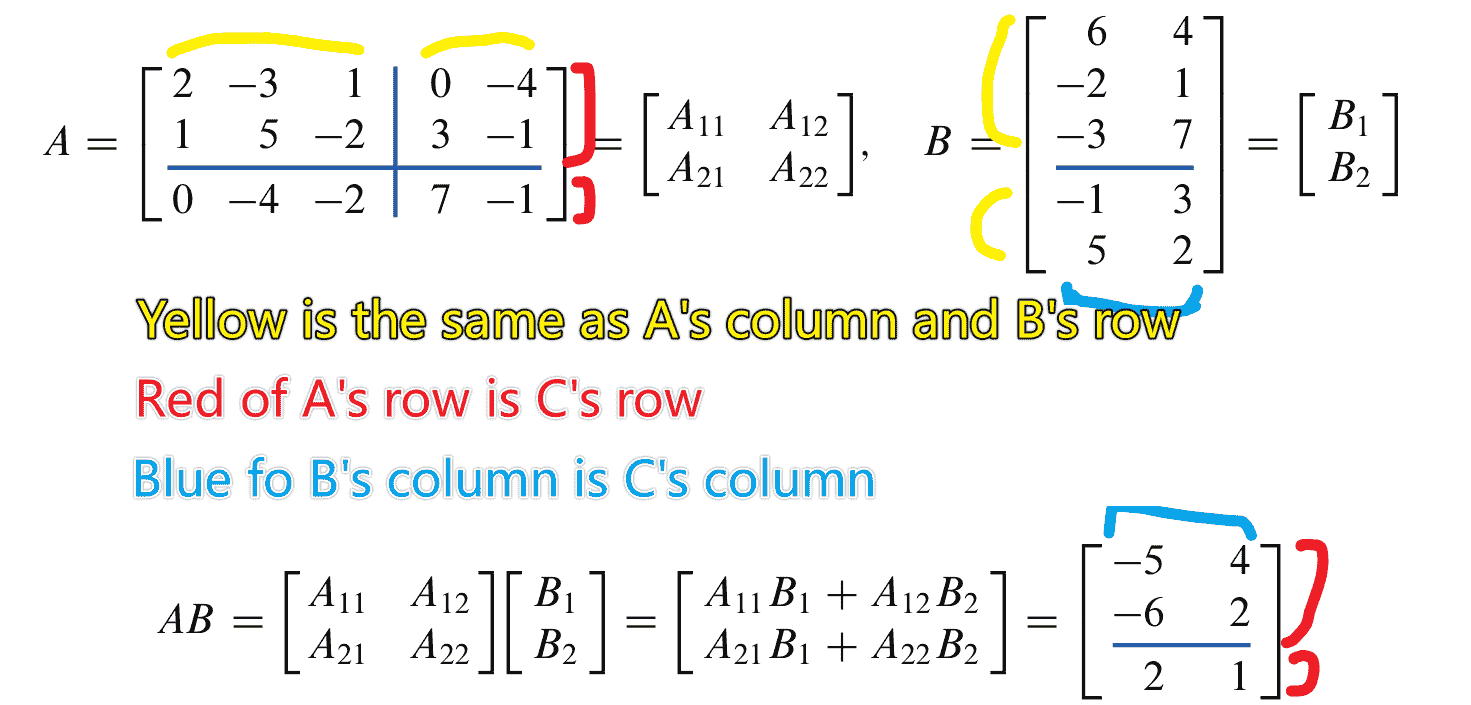
2. Partitioned Matrix (Block Matrix)
- Multiplication: Conformable (The column partition of is same as the row partition of ).
- Column-Row Expansion of :
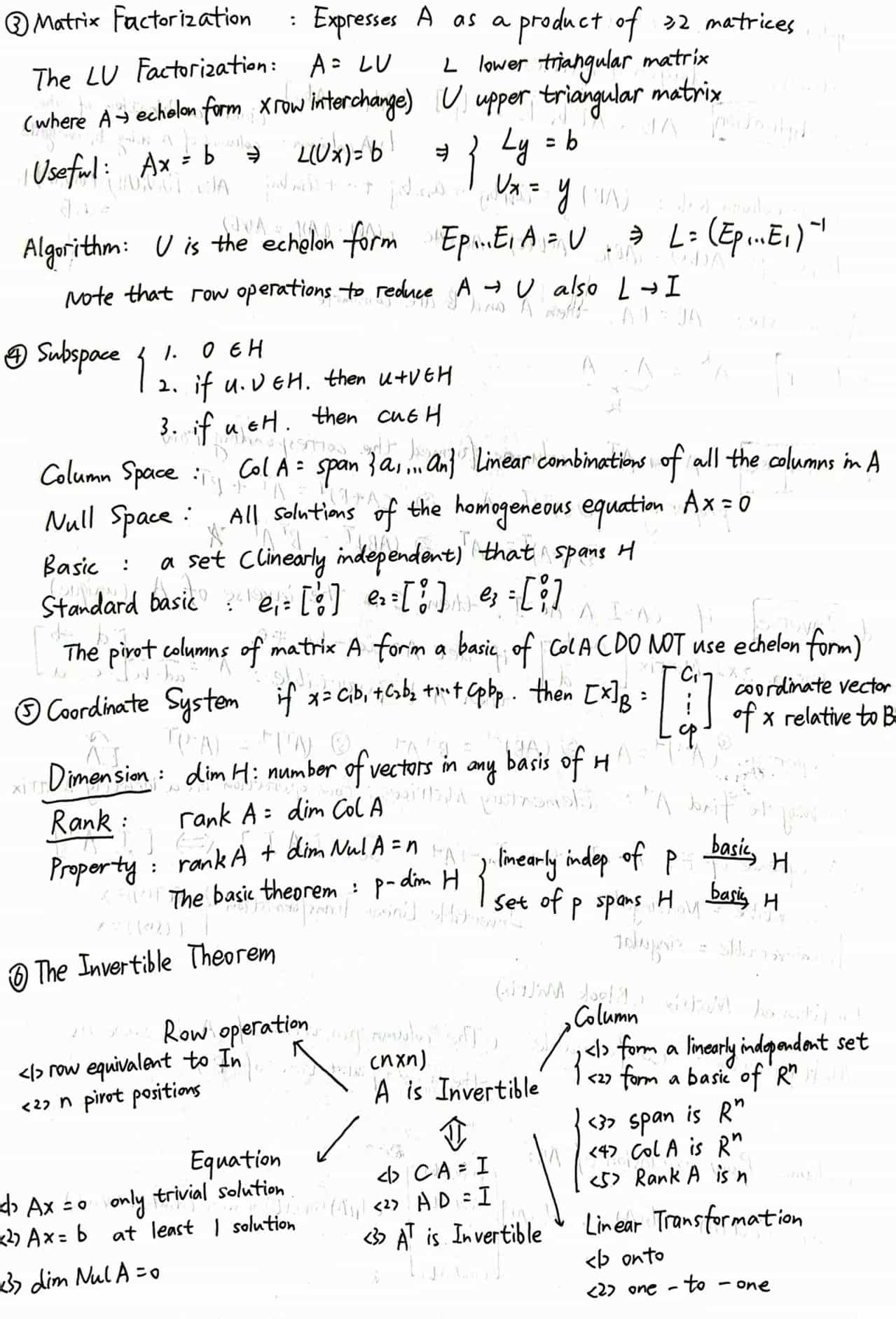
3. Matrix Factorization
Expresses as a product of 2 matrices.
The LU Factorization
-
- : Lower triangular matrix
- : Upper triangular matrix
- (Where echelon form without row interchange)
- Useful for solving :
- Algorithm:
- is the echelon form:
- Note that row operations to reduce also take .
4. Subspace
A subspace must satisfy:
- If , then
- If , then
- Column Space: (Linear combinations of all the columns in )
- Null Space: All solutions of the homogeneous equation
- Basis: A set (linearly independent) that spans
- Standard Basis:
- Important Note: The pivot columns of matrix form a basis of (DO NOT use echelon form).
5. Coordinate System
- If , then (Coordinate vector of relative to ).
- Dimension: : Number of vectors in any basis of .
- Rank: .
- Property (Rank-Nullity Theorem): .
- The Basis Theorem: Let .
- A linearly independent set of vectors in is automatically a basis for .
- A set of vectors that spans is automatically a basis for .
6. The Invertible Theorem
Let be an matrix. The following statements are equivalent ( is Invertible):
Row Operations:
- is row equivalent to
- has pivot positions
Equations:
- has only the trivial solution
- has at least one solution for each in
Columns:
- The columns of form a linearly independent set
- The columns of form a basis of
- The columns of span
Invertibility / Transpose:
- There exists an matrix such that
- There exists an matrix such that
- is invertible
Linear Transformation ():
- is onto (surjective)
- is one-to-one (injective)
本博客所有文章除特别声明外,均采用 CC BY-NC-SA 4.0 许可协议。转载请注明来源 zhangxixi的博客!
相关推荐
2026-09-28
Linear Algebra 2.4 - 2.5 Partitioned Matrix & Factorization
Linear Algebra 2.4 - 2.5 Partitioned Matrix & Factorization Section 2.4 Partitioned Matrix Addition and Scalar Multiplication If matrices A,BA,BA,B are the same size and are partitioned in exactly the same way, then A+BA+BA+B and cAcAcA holds. Multiplication the partitions of AAA and BBB...
2026-09-23
Linear Algebra 2.2 - 2.3 Inverse of Matrix
Linear Algebra 2.2 - 2.3 Inverse of Matrix Section 2.2 Inverse of Matrix An n×nn\times nn×n matrix AAA is said to be invertible if there is an n×nn\times nn×n matrix CCC such that : CA=I\and AC=I If we change \and to \or, it is also right. But it is not the definition. In this case is case, CCC ...
2026-09-21
Linear Algebra : Chapter 2.1 Matrix Operations
Linear Algebra : Chapter 2 Chapter 2 Matrix Algebra Section 2.1 Matrix Operations diagonal entries : a1,1,a2,2,…a_{1,1},a_{2,2},\dotsa1,1,a2,2,… diagonal matrix : all nondiagonal entries are all zero Equal : two matrix are equal iff they have same size scalar multiple : rArArA Matrix Multi...
2026-09-30
Linear Algebra 2.8 - 2.9 Subspace, dimension and rank
Linear Algebra 2.8 - 2.9 Subspace, dimension and rank Section 2.8 : Subspace of R^n A subspace of Rn\R^nRn if any set HHH in Rn\R^nRn that has 3 properties: The zero vector is in HHH For each uuu and vvv in HHH, then u+vu + vu+v is in HHH For each uuu in HHH and a scalar ccc, then cucucu is in H...
2026-09-02
Linear Algebra - 1
Linear Algebra - 1 Oct 24th 14-16pm Mid-term Exam Vectors = Data Matrices = Transformations Chapter 1 : Linear Equations Section 1.1 : Systems of Linear Equations linear equation system of linear equation solution set Equivalent : Two linear system have the same solution set Solution: no ex...