
Linear Algebra : Chapter 2.1 Matrix Operations
Linear Algebra : Chapter 2
Chapter 2 Matrix Algebra
Section 2.1 Matrix Operations
- diagonal entries :
- diagonal matrix : all nondiagonal entries are all zero
- Equal : two matrix are equal iff they have same size
- scalar multiple :
Matrix Multiplication
If is an matrix, and if is an matrix with columns , then the product is the matrix whose columns are . That is,
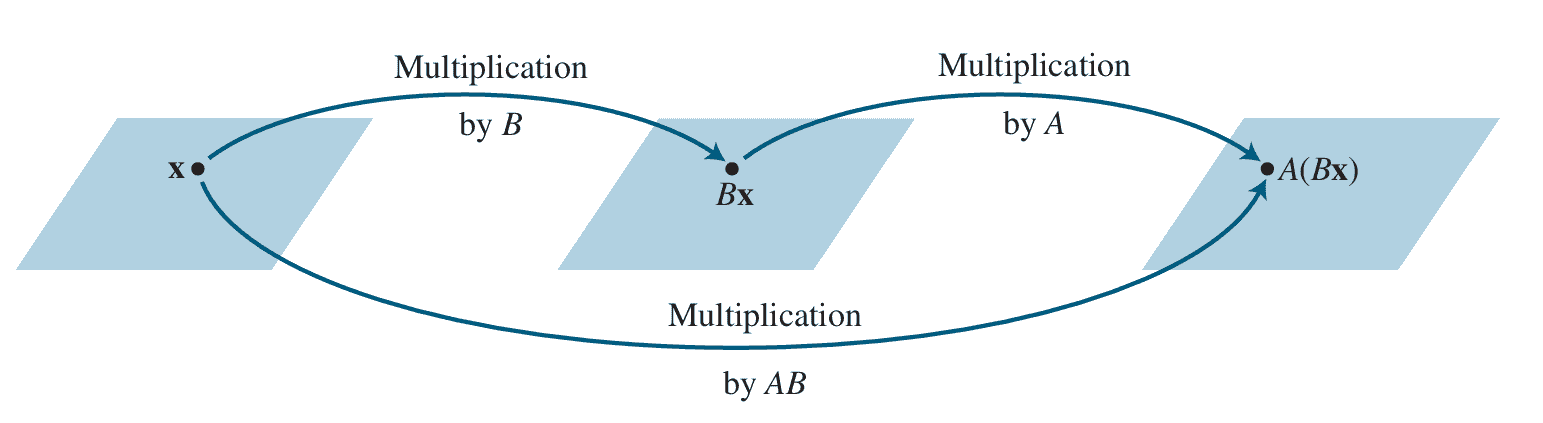
Notice that since the first column of is , this column is a linear combination of the columns of using the entries in as weights. A similar statement is true for each column of
The columns of are linear combinations of the columns of
Row-Column Rule For Computing AB :
Also, we have:
I think this is also true for column(as the definition)
Properties:
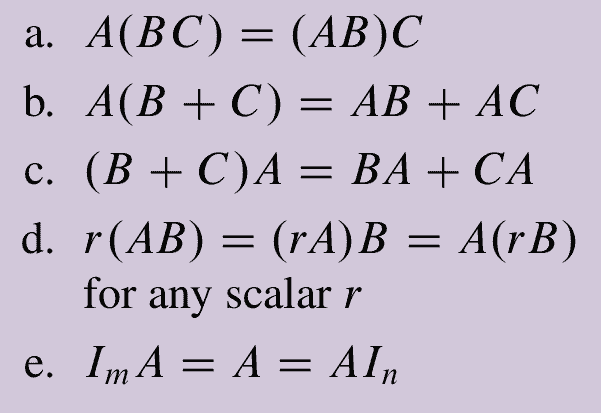
If , we say and are commute with one another.
Warning :
- In general,
- If , then in general
- If , you can not conclude or
I think if all the columns of are linearly independent, then we know
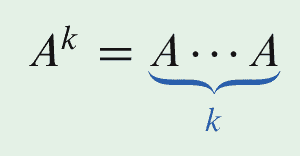
Power of Matrix
Transpose of a Matrix
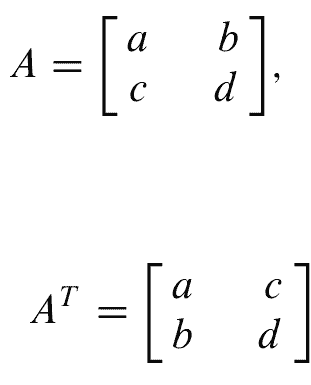
The transpose of a matrix , is a matrix, denoted by , whose columns are formed from the corresponding rows of .
Properties:
- (Important)
本博客所有文章除特别声明外,均采用 CC BY-NC-SA 4.0 许可协议。转载请注明来源 zhangxixi的博客!
相关推荐
2026-09-02
Linear Algebra - 1
Linear Algebra - 1 Oct 24th 14-16pm Mid-term Exam Vectors = Data Matrices = Transformations Chapter 1 : Linear Equations Section 1.1 : Systems of Linear Equations linear equation system of linear equation solution set Equivalent : Two linear system have the same solution set Solution: no ex...
2026-09-23
Linear Algebra 2.2 - 2.3 Inverse of Matrix
Linear Algebra 2.2 - 2.3 Inverse of Matrix Section 2.2 Inverse of Matrix An n×nn\times nn×n matrix AAA is said to be invertible if there is an n×nn\times nn×n matrix CCC such that : CA=I\and AC=I If we change \and to \or, it is also right. But it is not the definition. In this case is case, CCC ...
2026-09-28
Linear Algebra 2.4 - 2.5 Partitioned Matrix & Factorization
Linear Algebra 2.4 - 2.5 Partitioned Matrix & Factorization Section 2.4 Partitioned Matrix Addition and Scalar Multiplication If matrices A,BA,BA,B are the same size and are partitioned in exactly the same way, then A+BA+BA+B and cAcAcA holds. Multiplication the partitions of AAA and BBB...
2026-10-06
[Chapter 2 Summary] of Linear Algebra
[Chapter 2 Summary] of Linear Algebra Chapter 2 Matrix Algebra 1. Matrix Operations Diagonal entries a. Multiplication Definition: AB=A[b1 b2 … bp]=[Ab1 … Abp]AB = A[b_1 \ b_2 \ \dots \ b_p] = [Ab_1 \ \dots \ Ab_p]AB=A[b1 b2 … bp]=[Ab1 … Abp] Interpretation: AAA column is a linear combina...