Linear Algebra 2.2 - 2.3 Inverse of Matrix
Linear Algebra 2.2 - 2.3 Inverse of Matrix
Section 2.2 Inverse of Matrix
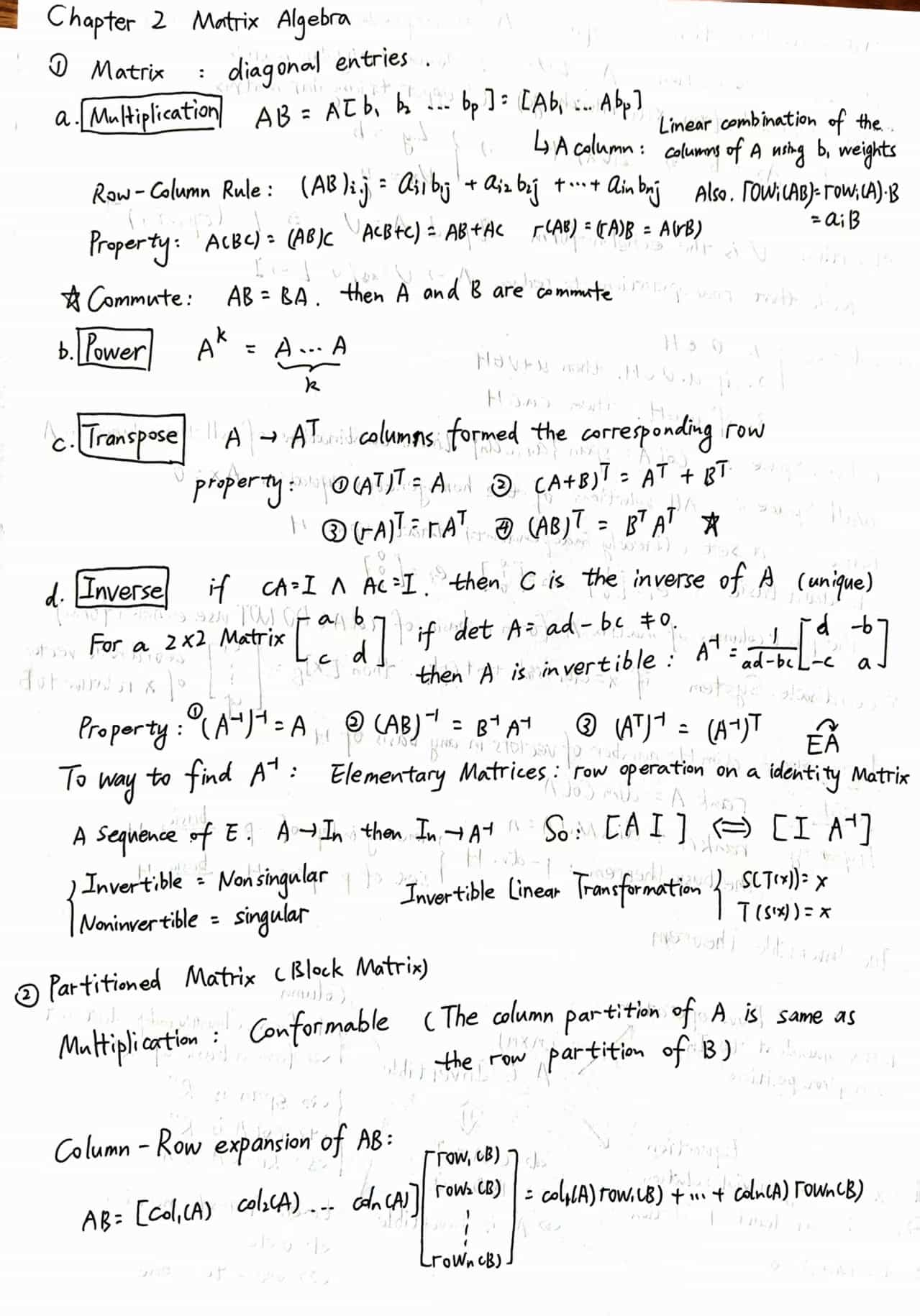
An matrix is said to be invertible if there is an matrix such that :
CA=I\and AC=I
If we change \and to \or, it is also right. But it is not the definition.
In this case is case, is an inverse of , and is uniquely determined by , we can write in .
Theorem
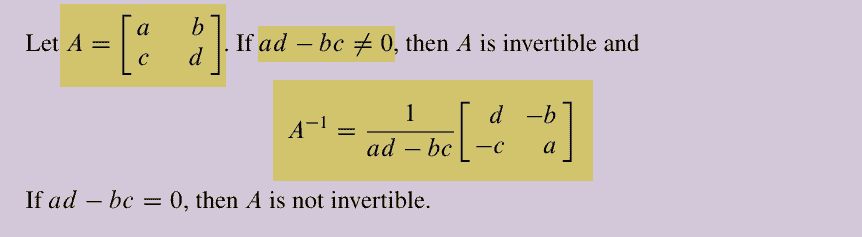
The quantity is called the determinant of , we can write :
Theorem
If is an invertible matrix, then for each in , the equation has the unique solution .
Theorem
- If is an invertible matrix, then is invertible and
- If and are invertible matrices, then so is . Then
- If is an invertible matrix, then
An invertible matrix is row equivalent to a identity matrix.
Elementary Matrices
An elementary matrix is one that is obtained by performing a single elementary row operation on an identity matrix.
If an elementary row operation is performed on an matrix , the resulting matrix can be written as , where the matrix is created by performing the same row operation on .
Each elementary matrix is invertible. The inverse of is the elementary matrix of the same type that transforms back to .
Theorem
An matrix is invertible, then any sequence of elementary row operations that reduces to also transforms to .
If have an inverse, then is row equivalent to .
This provide us an algorithm for finding .
Section 2.3 Characterizations of Invertible Matrices
This statement are all equivalent :
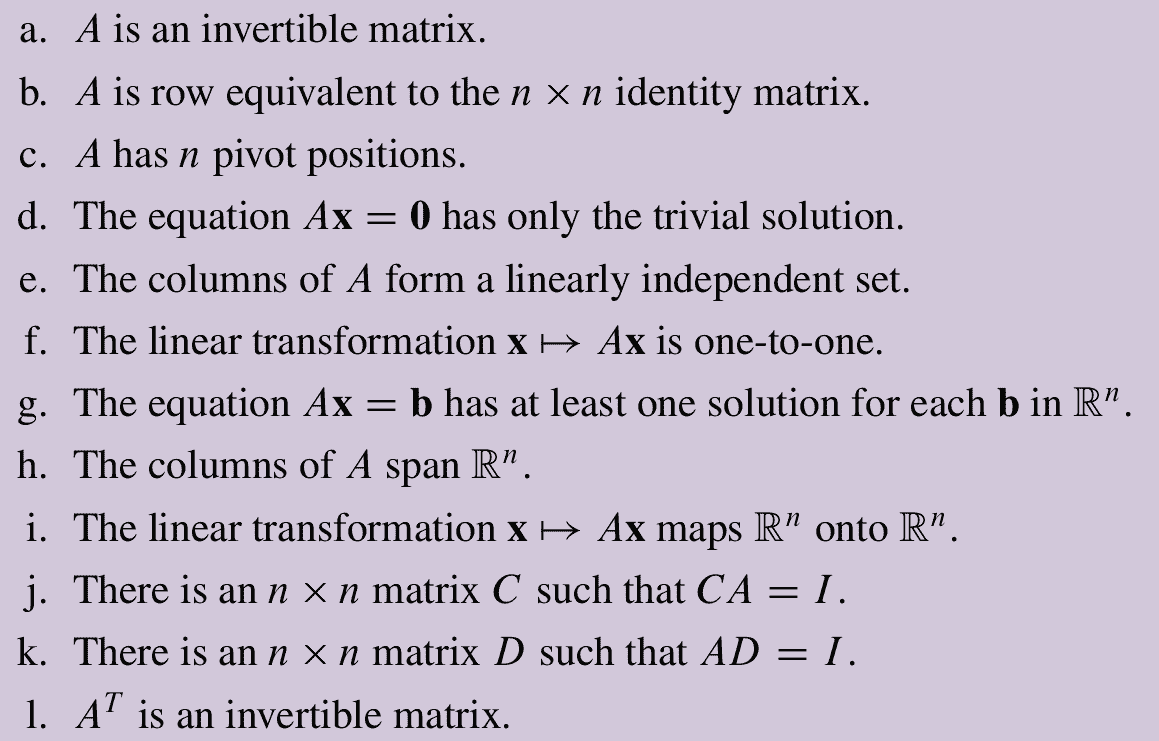
The Invertible Matrix Theorem
If is invertible, then is invertible and
This divide the set of all into 2 parts:
- Invertible = Nonsingular
- Noninvertible = singular
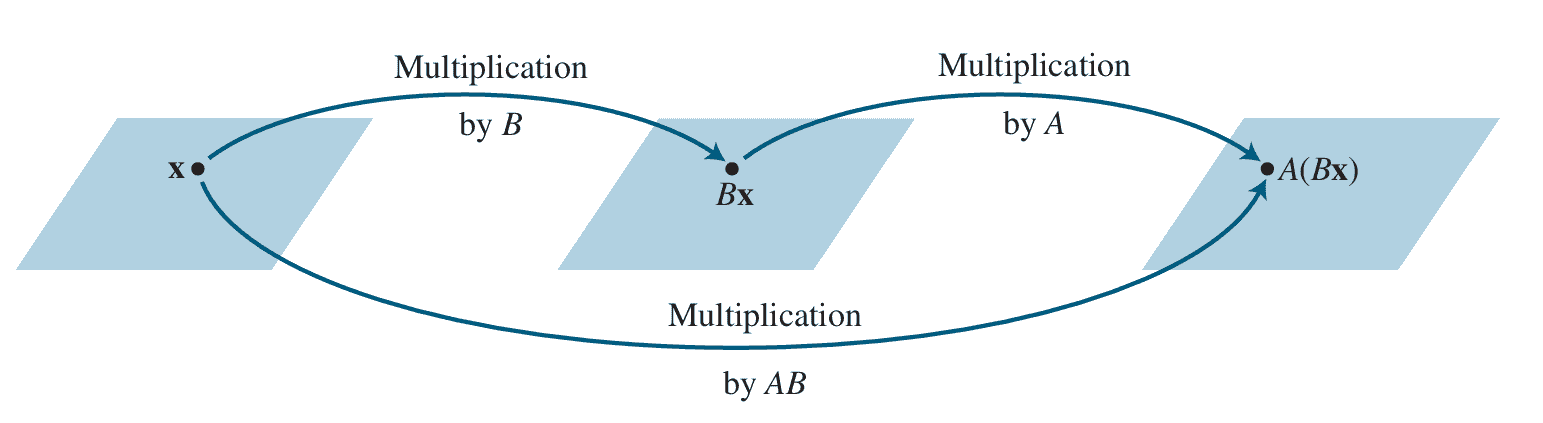
Invertible Linear Transformations
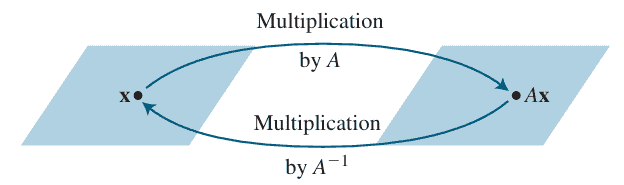
A Linear transformation is said to be invertible if there exists a functions such that :
- for all in
- for all in
We call is the inverse of and write it as .