Linear Algebra - 1
Linear Algebra - 1
Oct 24th 14-16pm Mid-term Exam
- Vectors = Data
- Matrices = Transformations
Chapter 1 : Linear Equations
Section 1.1 : Systems of Linear Equations
- linear equation
- system of linear equation
- solution set
- Equivalent : Two linear system have the same solution set
Solution:
- no
- exactly one
- infinitely many
For a system of linear equation:
- Consistent : one or infinite solutions
- Inconsistent : no solution
Coefficient Matrix

Augmented Matrix
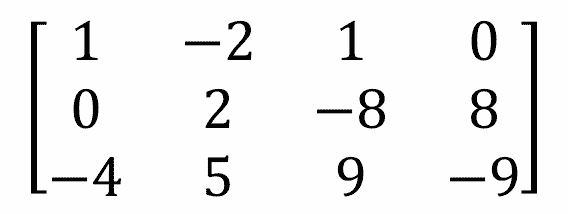
Matrix size : matrix is a rectangular with rows and columns
Elementary Row Operations
- Replacement : Row Addition
- Interchange : Row Swap
- Scaling : Row Scaling
Two matrices are called row equivalent if there is a sequence of elementary row operations that transforms one matrix into another one
If the augmented matrices of two linear systems are row equivalent, then the two systems have the same solution set.
Section 1.2: Row Reduction and Echelon Forms
Echelon form (or row echelon) : /ˈeʃəlɒn/
- All nonzero rows are above any rows of all zeros
- Each leading entry of a row is in a column to the right of the leading entry of the row above it
- All entries in a column below a leading entry are zeros
Reduced echelon form (or reduced row echelon form):
- The leading entry in each nonzero row is 1
- Each leading 1 is the only nonzero entry in its column
Theorem : Uniqueness of the Reduced Echelon Form
Each matrix is row equivalent to one and only one reduced echelon matrix.
Pivot
Get it from the reduced echelon form.
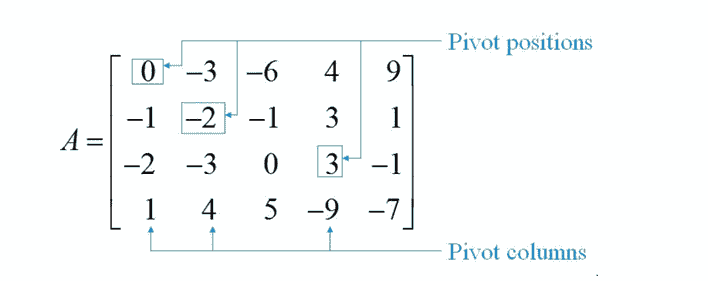
- Pivot Position : a location in A that corresponds to a leading 1 in the reduced echelon form of A
- Pivot column
Row Reduction Algorithm
- forward phase
- backward phase
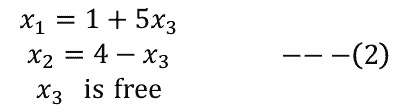
Pivot columns are called basic variables, while other are called free variables
Parametric Descriptions of Solution Sets: