Linear Algebra 2.8 - 2.9 Subspace, dimension and rank
Linear Algebra 2.8 - 2.9 Subspace, dimension and rank
Section 2.8 : Subspace of R^n
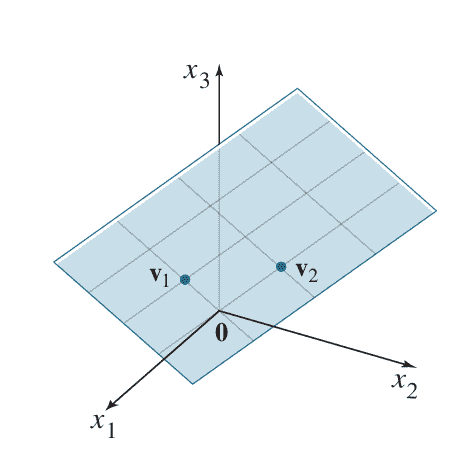
A subspace of if any set in that has 3 properties:
- The zero vector is in
- For each and in , then is in
- For each in and a scalar , then is in
Column Space
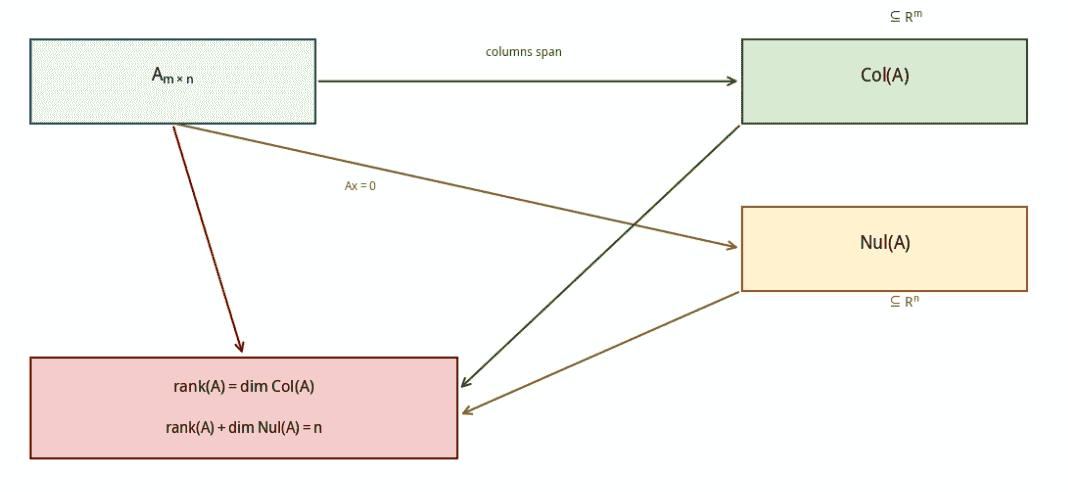
The Column space of a matrix is the set of all linear combinations of the columns of .
If , with the columns in , then is the same as .
The column space of an matrix is a subspace of .
Null Space
The null space of a matrix is the set of all solutions of the homogenous equation
The null space of an matrix is a subspace of
Basic for a Subspace
A basic of a subspace of is a linearly independent set in that spans .
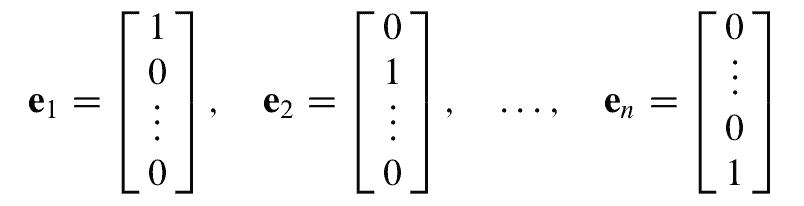
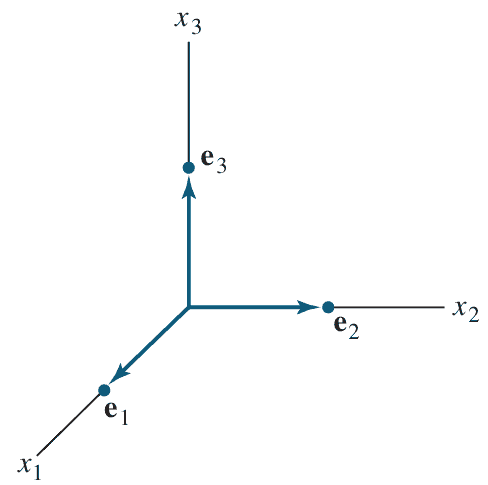
The set is called the standard basic for .
The pivot columns of matrix form a basis for the column space of .
Warning:
Be careful to use pivot columns of itself for the basis of . DO NOT use the columns of an echelon form!!!
Section 1.9 Dimension and Rank
Coordinate System
Suppose the set is a basis for a subspace . For each in , the coordinates of relative to the basis are the weights such that , and the vector in :
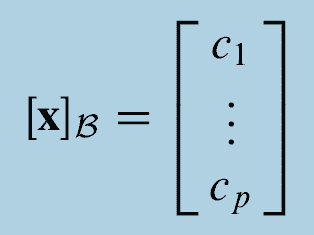
is called the coordinate vector of (relative to ) or the B-coordinate vector of .
The Dimension of A Subspace
The dimension of a nonzero subspace , denoted by dim H, is the number of vectors in any basis for . The dimension of the zero subspace is defined to be zero.
The rank of a matrix , denoted by rank A, is the dimension of the column space of . 2
The Rank Theorem
If a matrix has columns, then .
The Basic Theorem
Let be a p-dimensional subspace of .
- Any linearly independent set of exactly elements in is automatically a basis for .
- Any set of elements of that spans is automatically a basis for .
The Invertible Theorem (continued)
is an invertible matrix iff:
- The columns of form a basis of