Honors Calculus I - 2.2 Limits of Functions
Function Limit
Definition of limx→af(x)=L
∀ε>0,∃δ>0,∀x:0<∣x−a∣<δ∣f(x)−L∣<ε
The limit of function f at a equals L.
Cauchy criterion:
For every ε>0, there exists a δ>0 such that ∣f(x)−f(y)∣<ε for all x,y satisfying 0<∣x−a∣<δ,0<∣x−y∣<δ
Heine Theorem
The limit of the function f(x) as x approached a is L iff for every sequence {xn}, with xn=a for sufficiently large n that converges to a, the sequence of function values {f(xn)} converges to L.
Rules
- Arithmetic Rules
- The order Rules
- Squeeze Theorem
The composition Rule
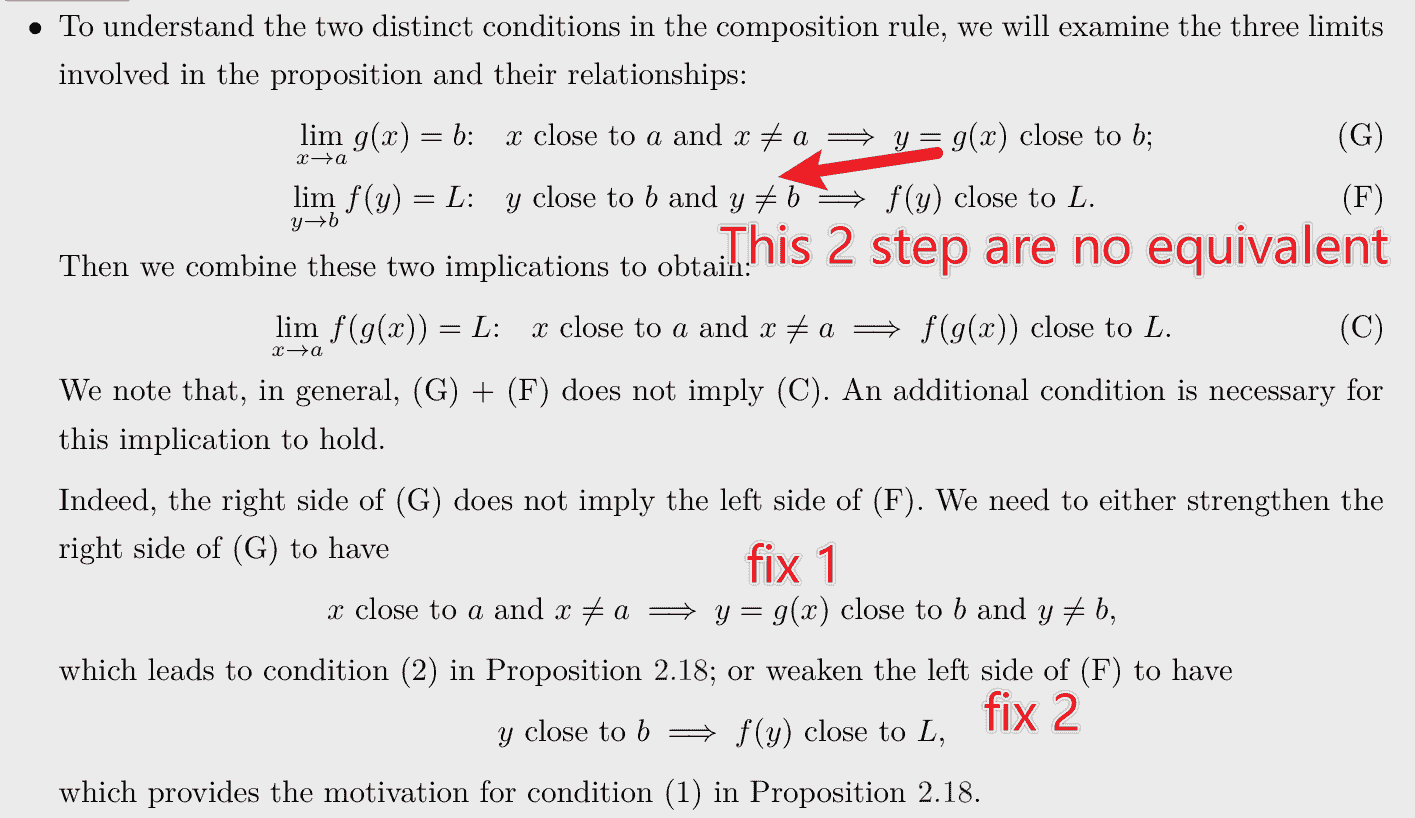
Suppose limy→bf(y)=L,limx→ag(x)=b, then
x→alimf(g(x))=L
provided at least one of the following holds:
- f(b)=L
- g(x)=b near x=a except possibly at a
Interpretation:
The order rule for function limits
Suppose that f and g with :
x→alimf(x)=Ax→alimg(x)=B
- If A<B, then ∃δ that ∀∣x−a∣<δ, f(x)<g(x)
- If there is a δ0 that ∀∣x−a∣<δ0 that satisfy f(x)≤g(x), then A≤B
Remark: If f(x)<g(x) near a, it is incorrect to conclude that A<B.
Squeeze Theorem for function limits
If exists δ0 that ∀x:∣x−a∣<δ :
g(x)≤f(x)≤h(x)
Then if limx→ag(x)=limx→ah(x)=L, then limx→af(x)=L.
One Sided Limits
- Left-hand limit : For ∀ε>0, there ∃δ>0 that ∀x:a−δ<x<a, then ∣f(x)−L∣<ε, we can write in limx→a−f(x)=L
- Right-hand limit : same but a<x<a+δ. Write in limx→a+f(x)=L
The limit limx→af(x)=L iff both one-sided limits limx→a−f(x)=limx→a+f(x)=L
Some basic limits of functions
- limx→axp=ap
- limx→abx=ba, where b>0
- limx→alogbx=logba, where 0<b=1
- limx→asinx=sina, limx→acosx=cosa
- limx→axsinx=1
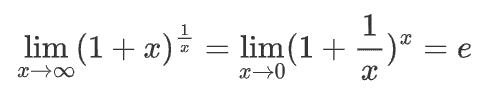
- limx→0(1+x)x1=e
Limits in the Extended Real Number System
Neighborhood of infinite:
For any real c, the set of real numbers x such that x>c is called a neighborhood of ∞ and is written (c,∞). Similarly, the set (−∞,c) is a neighborhood of −∞.
Suppose, p,q∈R, we denote limx→pf(x)=q iff:
for every neighborhood U of q, there is a neighborhood V of p such that f(x)∈U for all x∈V,x=p
-
Uniqueness
-
Cauchy Criterion also applies
-
In fact, the neighborhoods of ∞ and −∞ are inherently one sided
-
The order rule, arithmetic rules, the composition rules, and the Squeeze Theorem also holds.
Limits at infinity
When p is infinite and q is finite:
limx→∞f(x)=q or limx→−∞f(x)=q
- horizontal asymptote
- limx→∞f(x)=b or limx→−∞f(x)=b
- slant asymptote
- limx→∞[f(x)−(mx+b)]=0 or limx→−∞[f(x)−(mx+b)]=0
Infinite Limits
If p is finite and q is infinite:
x→plimf(x)=∞
Vertical asymptote:

It must be noted that a zero of the denominator ⇎a vertical asymptote.