
Honors Calculus I - 2.1 Sequences
Honors Calculus I - 2.1 Sequences
Sequences
An infinite sequence is converge to ( is called the limit)iff:
If not, it is called divergent.
Above is called the definition. (which can also use to prove is converge to )
Equivalent statement :
For every , there exists a number such that for all , the equality holds, where is a function satisfying .
Proof Method / Example :
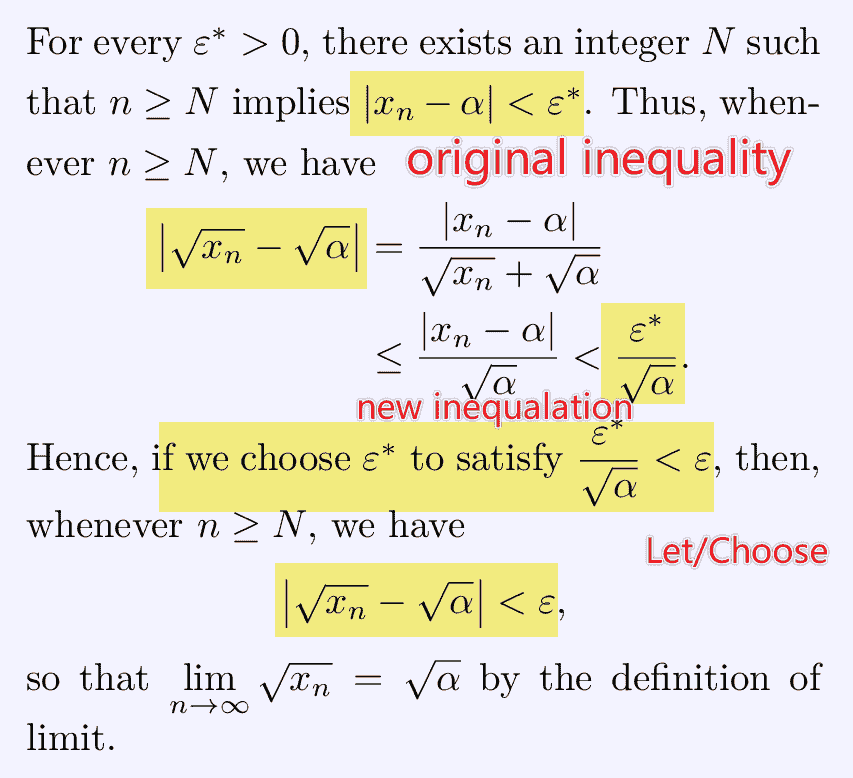
Little - o notation

Properties
- If , and , Then
- Sequences converges to iff for all but finitely many
- If converges, then is bounded.
Arithmetic Rules
- Sum Rule, Difference Rule, Product Rule, Quotient Rule
the Order Rule
Suppose
- If , then
- If , then exists satisfy
Squeeze Theorem for sequences
If , and if , then
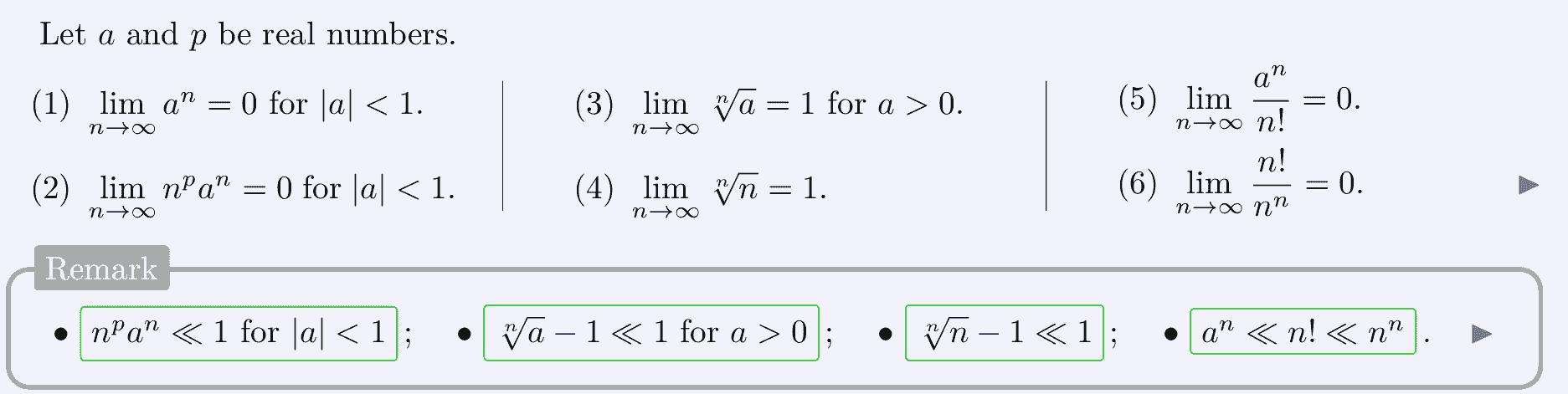
Several Common Limits
Monotonic Sequences
Monotone Convergence Theorem : A monotonic sequences converges iff it is bounded
A trick:
To prove a sequence is converge :
- Construct two bounded monotonic sequences, then we know they are converge
- Prove , So the two sequences have the same limit
- Squeeze Theorem
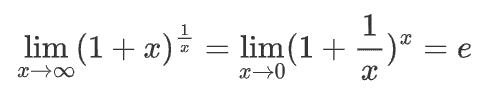
Euler’s number :
Subsequences
Omit some terms from a sequence , and we get a subsequence , which is also infinite.
- Convergence of subsequence : If converges to , then every also converges to
- Bolzano-Weierstrass Theorem : Every bounded sequence has at least one convergent subsequence. (这个东西很重要,用于解决自变量收敛的问题)
Cauchy Criterion
A sequence converge iff :
Infinite Limit of Sequence
is divergent to if :
We can write .
- If , then
- Suppose for all . Then iff .
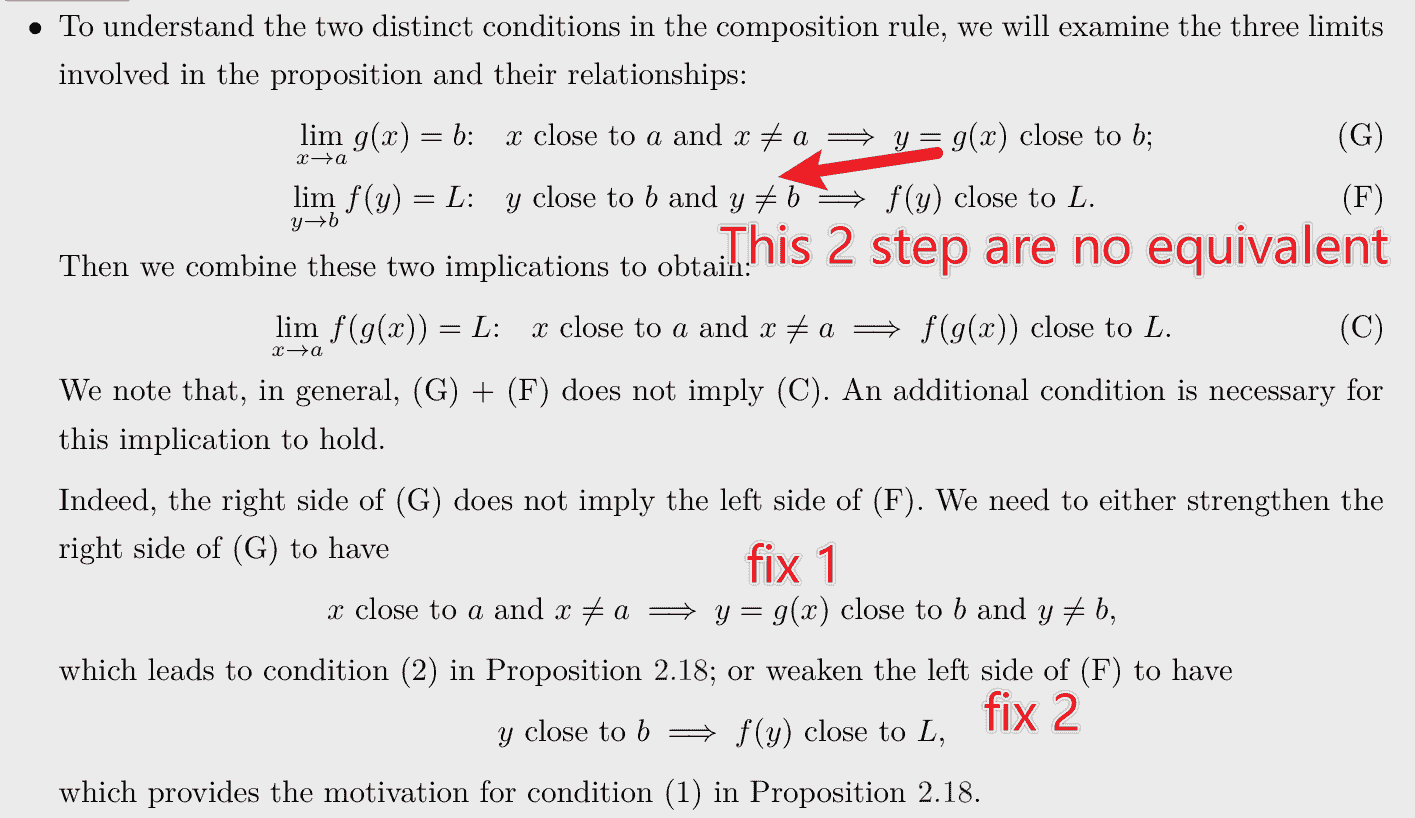
Note that :
If we use change variable to calculate limit, note the limit of the variable itself, for example:
本博客所有文章除特别声明外,均采用 CC BY-NC-SA 4.0 许可协议。转载请注明来源 zhangxixi的博客!
相关推荐
2026-09-29
Honors Calculus I - 2.2 Limits of Functions
Honors Calculus I - 2.2 Limits of Functions Function Limit Definition of limx→af(x)=L\lim_{x\to a}f(x)=Llimx→af(x)=L ∀ε>0, ∃δ>0, ∀x: 0<∣x−a∣<δ∣f(x)−L∣<ε\forall \varepsilon >0, \;\exist \delta >0,\;\forall x:\,0<|x-a|<\delta\\ |f(x)-L|<\varepsilon ∀ε>0,∃δ>0,...
2026-10-09
Calculus - Limit 做题简记1
Calculus - Limit 做题简记1 T1:函数极限的一些求法 2.48 - 4 limx→1x3−1x2+e1x−1\lim_{x\to 1}\frac{x^3-1}{x^2+e^{\frac 1{x-1}}} x→1limx2+ex−11x3−1 犯错之处:采用了乘 ex−1e^{x-1}ex−1,但指数是相加不是相乘,导致出错 Squeeze Theorem中的绝对值法 上界是很好放的,但下界我们不能说明其 ≥0\ge 0≥0 我们的方法是,我们先求 ∣x3−1x2+e1x−1∣|\dfrac{x^3-1}{x^2+e^{\frac 1{x-1}}}|∣x2+...
2026-10-14
Calculus - Limit 做题简记2
Calculus - Limit 做题简记2 Key Point sufficiently large 的必须转化为:∃N,∀n≥N,...\exist N,\forall n\ge N,...∃N,∀n≥N,...,而不能在前面直接使用 Let ε=l\varepsilon = lε=l 中,一定要判断这些 lll 是否大于0 T1 : Induction to Prove Monotonic 2.30 xn=α+xn−1x_n=\sqrt{\alpha+x_{n-1}} xn=α+xn−1 证明 xn{x_n}xn monotonic increasing 这种证明很...