
计算几何+欧拉回路合并:1222T2
计算几何+欧拉回路合并:1222T2
本文搬运自本人高中时期CSDN博客,若图片加载不出来,可到原文查看:https://blog.csdn.net/zhangtingxiqwq/article/details/135152697
http://47.92.197.167:5283/contest/435/problem/2
2度点直接求夹角即可,4度角我是贪心选最小的情况。
但比如这样子:
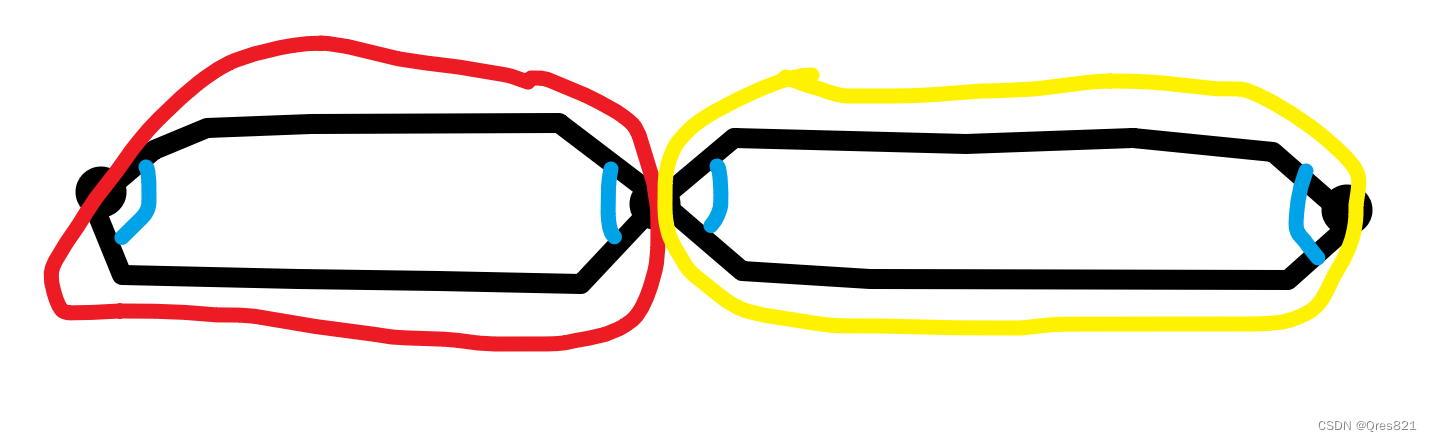
我们会贪心选了4个蓝色角,形成红色和黄色两个欧拉回路,这就不是一个欧拉回路了。因此我们要考虑欧拉回路合并。
发现我们对于每个点划分成的两个集合各选一条边练一起,就可以合并两个欧=拉回路了。我们要使代价最小,相当于求以欧拉回路为点的最小生树。
1 | preparing at 14:11 |
1 |
|
本博客所有文章除特别声明外,均采用 CC BY-NC-SA 4.0 许可协议。转载请注明来源 zhangxixi的博客!
相关推荐

2022-05-18
【一本通1489:构造完全图】题解
本文搬运自本人初中博客园博客,若图片加载不出来,可到原文查看:https://www.cnblogs.com/zhangtingxi/p/16285749.html 题目链接 题目 对于完全图 GGG,若有且仅有一棵最小生成树为 TTT,则称完全图 GGG 是树 TTT 扩展出的。 给你一棵树 TTT,找出 TTT 能扩展出的边权和最小的完全图 GGG。 思路 要使一个图总存在唯一最小生成树,需满足所有非最小生成树的边(假设连接 u,vu,vu,v),使这条边的边权 www 大于 u,vu,vu,v 在最小生成树上的最短路径的最大边权。 因此,我们可以先dfs一遍求出每个点到根节点...

2021-12-16
【[AGC019F] Yes or No】题解
本文搬运自本人初中博客园博客,若图片加载不出来,可到原文查看:https://www.cnblogs.com/zhangtingxi/p/15699367.html 题目链接 题目 有 N+MN+MN+M 个问题,其中有 NNN 个问题的答案是 YES,MMM 个问题的答案是 NO。当你回答一个问题之后,会知道这个问题的答案,求最优策略下期望对多少。 答案对 998244353998244353998244353 取模。 思路 首先假设撇开算期望,就一个贪心,如果 n>mn>mn>m,我们就会不断答yes,然后至少答对 nnn 题。 于是总的来说,至少答对 max...

2021-12-11
【Loj #10013. 「一本通 1.2 例 3」曲线】题解
本文搬运自本人初中博客园博客,若图片加载不出来,可到原文查看:https://www.cnblogs.com/zhangtingxi/p/15674711.html 题目链接 题目 明明做作业的时候遇到了 nnn 个二次函数 Si(x)=ax2+bx+cS_i(x)= ax^2 + bx + cSi(x)=ax2+bx+c,他突发奇想设计了一个新的函数 F(x)=max{Si(x)},i=1…nF(x) = max{S_i(x)}, i = 1ldots nF(x)=max{Si(x)},i=1…n。 明明现在想求这个函数在 [0,1000][0,1000][0,1...

2021-12-15
【P2571 [SCOI2010]传送带】题解
本文搬运自本人初中博客园博客,若图片加载不出来,可到原文查看:https://www.cnblogs.com/zhangtingxi/p/15693858.html 题目链接 题目 在一个 222 维平面上有两条传送带,每一条传送带可以看成是一条线段。两条传送带分别为线段 AB\text{AB}AB 和线段 CD\text{CD}CD。lxhgww 在 AB\text{AB}AB 上的移动速度为 PPP,在 CD\text{CD}CD 上的移动速度为 QQQ,在平面上的移动速度 RRR。现在 lxhgww 想从 A\text AA 点走到 D\text DD 点,他想知道最少需要走多...
2026-10-04
分治 + 计算几何 + 闵可夫斯基和:ABC478G
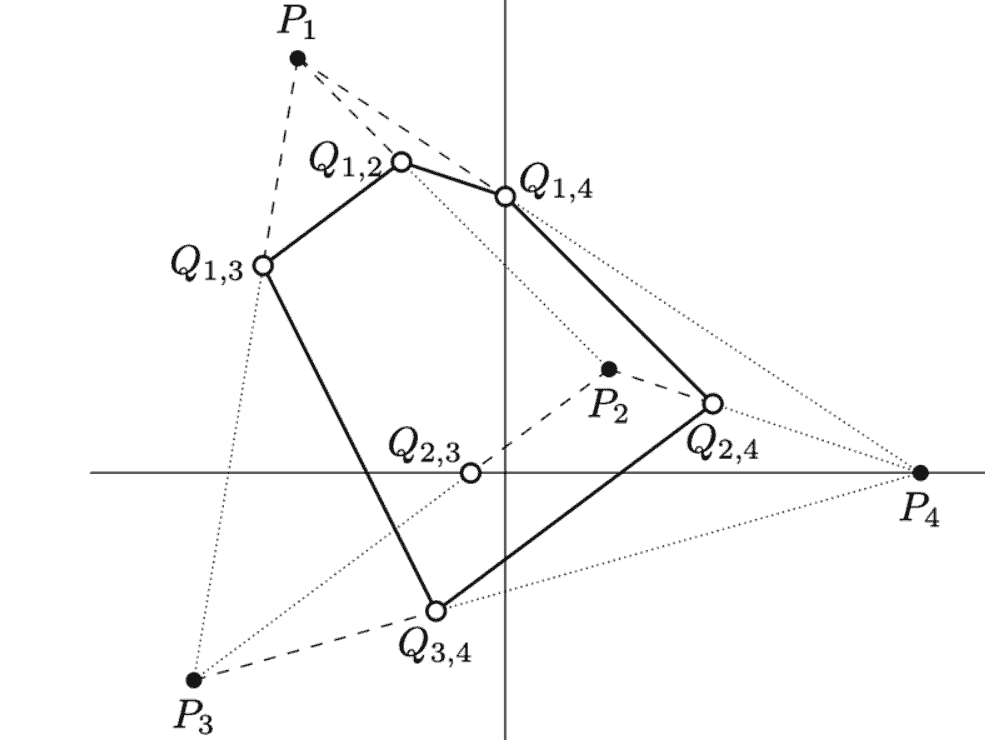
分治 + 计算几何 + 闵可夫斯基和:ABC478G G - Division Point Hull 考虑用坐标点来表示 Qi,jQ_{i,j}Qi,j: Qi,j=qp+qPi+pp+qPjQ_{i,j}=\frac q{p+q}P_i+\frac p {p + q}P_j Qi,j=p+qqPi+p+qpPj 我们考虑分治来处理。先递归得到左右两边 QQQ 组成的凸包 QL,QRQ_L,Q_RQL,QR 我们现在需要得到跨区间 QQQ。根据上面的式子,我们发现其实我们只需要得到左右两边 PPP 组成的凸包,然后左边缩小到 qp+q\dfrac q{p+q}p+qq...

2021-11-14
坐标系中三角形面积求法
本文搬运自本人初中博客园博客,若图片加载不出来,可到原文查看:https://www.cnblogs.com/zhangtingxi/p/15551910.html 之前打atcoder时不会这个东西,下大分,现在赶快补 仅用于个人备忘 坐标系中三角形面积求法 已知三角形三点坐标为 A(x1,y1),B(x2,y2),C(x3,y3)A(x_1, y_1),B(x_2, y_2), C(x_3, y_3)A(x1,y1),B(x2,y2),C(x3,y3) 则三角形面积为: S△ABC=∣(x2−x1)(y3−y1)−(x3−x1)(y2−y1)∣2S_{\triangl...