
对于每种情况分别统计概率来计算期望+树上连通块统计:ARC165E
对于每种情况分别统计概率来计算期望+树上连通块统计:ARC165E
本文搬运自本人高中时期CSDN博客,若图片加载不出来,可到原文查看:https://blog.csdn.net/zhangtingxiqwq/article/details/132971902
https://atcoder.jp/contests/arc165/tasks/arc165_e
考虑一个常见套路,我们对每个连通块统计其概率,设为 ,则答案为
可以想成对于每个大小大于 的连通块,都要至少选一个点,也就是进行一次操作。所以我们就统计所以这么大的连通块存在的概率,乘上1,就是其期望。总期望就是单独的期望之和。
然后一些显然的性质,一个连通块必然是树上的一个子树弄走它的一堆子树。而且要形成这样一个连通块,连通块内的点一定没有被选,而且和连通块相邻的所有点一定全部被选过。
那么我们现在就发现决定一个连通块贡献的性质。有了这个性质,我们就可以合并等价类了。
在合并之前,我们先考虑 个点的块, 个点相连的概率。这 个点必然早于这 个点先被选。
但我们发现操作的先后可能影响一个点是否被选。
有一种常见套路,就是我们直接枚举操作顺序,这个操作顺序代表中如果某个点所在连通块大小小于等于 ,我们可以视为跳过这个操作。所以对于任意 个点的操作方案为
所以 个点的块, 个点相连的概率为
这一步也可以操作官方题解的转化来理解:

然后回到前面那个问题,如何计算合法 对呢?
因为这是一棵树,直接树形dp就行。数据范围就100,暴力转移即可。
复杂度
1 |
|
本博客所有文章除特别声明外,均采用 CC BY-NC-SA 4.0 许可协议。转载请注明来源 zhangxixi的博客!
相关推荐
2023-09-27
DP维护概率算期望+DP状态大小分析+DP状态维护前缀和:CF494C
dp维护概率算期望+dp状态大小分析+dp状态维护前缀和:CF494C 本文搬运自本人高中时期CSDN博客,若图片加载不出来,可到原文查看:https://blog.csdn.net/zhangtingxiqwq/article/details/133343917 https://www.luogu.com.cn/problem/CF494C 首先无交,先建树,然后上dp,三个优化 dp维护概率算期望 发现期望很难直接维护,直接维护某种值得概率,最后乘起来算期望 dp状态大小分析 发现这样子第二维会很大。但其最大值范围只在 [mx,mx+q][mx,mx+q][mx,mx+q] 内,...

2023-09-03
用树形DP+状压维护树上操作的计数问题:0902T3
用树形dp+状压维护树上操作的计数问题:0902T3 本文搬运自本人高中时期CSDN博客,若图片加载不出来,可到原文查看:https://blog.csdn.net/zhangtingxiqwq/article/details/132647373 发现操作数 k≤6k\le6k≤6 ,可以考虑对操作进行 状压 。 然后找找性质,发现要么删掉一棵子树,要么进去该子树。可以视为每种操作有两种情况。 然后分讨一下当前该如何转移。 树形dp的顺序: 合并子树 考虑当前往上的边的方向 然后发现只需要记住最早一次保留操作就行。 对于连通块大小的限制,就看一下当前操作之前有多少个子...
2026-10-16
期望 + dp + 计数 + 策略转限制:ICPC2025沈阳E
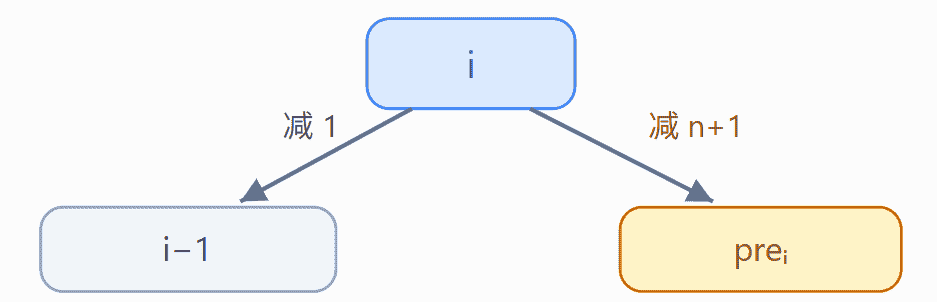
期望 + dp + 计数 + 策略转限制:ICPC2025沈阳E Play It by Ear - Problem - QOJ.ac 令 posxpos_xposx 表示编号为 xxx 的牌在原先牌堆的位置。 设 fif_ifi 表示完成第 iii 步(aia_iai 牌打出),至少需要多少步。设对于 aia_iai 这张牌,上一次出现在 preipre_iprei 的位置,那样子有: fi≥fi−1+1fi≥fprei+n+1f_i\ge f_{i-1}+1\\ f_i\ge f_{pre_i} + n + 1 fi≥fi−1+1fi≥fprei+n+1 因为上一...

2023-12-11
普通环的构造计数——计数链,然后合成:1211T3
普通环的构造计数——计数链,然后合成:1211T3 本文搬运自本人高中时期CSDN博客,若图片加载不出来,可到原文查看:https://blog.csdn.net/zhangtingxiqwq/article/details/134929628 http://47.92.197.167:5283/contest/437/problem/3 我们要构造环,肯定要构造链,然后题目还和我们说了是个二分图,我们就让链的端点在同一边(假定在右边) 那样考虑左边每个点又什么用?很显然,粘!可以把两条链粘一起,或者把链变成环。 所有很明显了,我们直接dp。 f(i,j)f(i,j)f(i,j) 表...

2021-12-01
【Loj #10104. 「一本通 3.6 练习 5」Blockade】题解
本文搬运自本人初中博客园博客,若图片加载不出来,可到原文查看:https://www.cnblogs.com/zhangtingxi/p/15629936.html 题目链接 首先这个点删去之后必然与剩下 n−1n-1n−1 个点失去相连。 如果这个点能使其它点失去相连,说明这个点为割点。 然后统计一下每个儿子与父亲的影响即可。 Code 1234567891011121314151617181920212223242526272829303132333435363738394041424344454647484950515253545556575859606162636465666...

2021-11-24
【P1270 “访问”美术馆】题解
本文搬运自本人初中博客园博客,若图片加载不出来,可到原文查看:https://www.cnblogs.com/zhangtingxi/p/15600574.html 题目链接 典型的树形dp。 设 dp(x,i)dp(x, i)dp(x,i) 表示 xxx 的子树内逗留 iii 秒的作品最大值。 dp(x,i)=maxy∈xmaxi=0smaxj=2×zidp(y,j−2×z)−dp(x,j−i)dp(x, i)=\max_{y\in x}\max_{i=0}^s\max_{j=2\times z}^i dp(y,j-2\times z)-dp(x,j-i) dp(x,i)=y...