
排列与置换换+容斥+多项式生成函数启发式合并:[Gym-103446B]
排列与置换换+容斥+多项式生成函数启发式合并:[Gym-103446B]
本文搬运自本人高中时期CSDN博客,若图片加载不出来,可到原文查看:https://blog.csdn.net/zhangtingxiqwq/article/details/134243178
https://vjudge.net/contest/591700#problem/G
看到排列,先考虑置换换,题意转化为置换环相邻的不能再最终序列上相邻
而这个过程看起来很容斥,所以我们容斥:至少要 个相邻
我们发现每个置换环的所有边不能全部同时被选,所以我们每个置换环要分开考虑,最后再乘起来
然而这样的复杂度会炸。但是我们可以写成生成函数的形式,然后用启发式合并起来
1 |
|
本博客所有文章除特别声明外,均采用 CC BY-NC-SA 4.0 许可协议。转载请注明来源 zhangxixi的博客!
相关推荐

2023-09-25
生成函数套sperner定理+哈夫曼树思想维护多个多项式乘法:CF1257G
生成函数套sperner定理+哈夫曼树思想维护多个多项式乘法:CF1257G 本文搬运自本人高中时期CSDN博客,若图片加载不出来,可到原文查看:https://blog.csdn.net/zhangtingxiqwq/article/details/133270189 首先有spener定理,肯定选 m2\frac m 22m 最优 那怎么计算本质不同的选数方案呢?根据一些生成函数的知识,某个质数出现次数为 ccc ,我们就可以令其为 1+x+x2+⋯+xc1+x+x^2+\dots+x^c1+x+x2+⋯+xc ,然后所有多项式相乘的第 m2\frac m 22m 项即为答案...

2023-09-18
简单的反射容斥与多项式快速幂:Loj#6738. 王的象棋世界
简单的反射容斥与多项式快速幂:Loj#6738. 王的象棋世界 本文搬运自本人高中时期CSDN博客,若图片加载不出来,可到原文查看:https://blog.csdn.net/zhangtingxiqwq/article/details/132978606 首先看到不能走出边界,发现是个反射容斥 对于此题,我们可以采用循环卷积来实现反射容斥 也就是说,如果我们走出了边界,相当于就是走到了另一边 而实现这个过程我们可以把卷完后 i+pi+pi+p 的部分直接平移到 iii 就行 加速这个过程可以用多项式快速幂 1234567891011121314151617181920212223...
2026-07-25
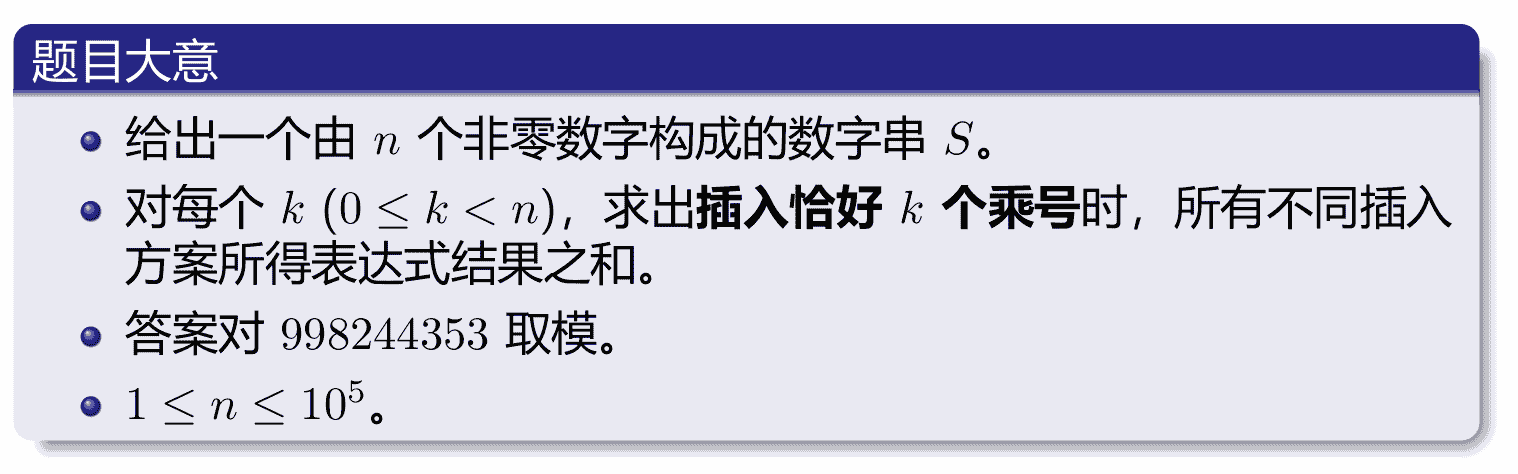
矩阵+NTT生成函数优化dp:2026暑杭电 2-02 表达式 2
矩阵+NTT生成函数优化dp:2026暑杭电 2-02 表达式 2 1002 表达式 2 dp 设 fi,kf_{i,k}fi,k 表示前 iii 个数字插入 kkk 个乘号的答案 gi,kg_{i,k}gi,k 表示前 iii 个数字,插入 kkk 个乘号,除了最后一段,前面每项的答案。 我们可以列出状态转移方程: fi,k=fi−1,k×10+si⋅gi,k(添加乘号)+fi−1,k−1⋅si(不添加乘号)f_{i,k} = f_{i-1,k} \times 10 + s_i \cdot g_{i,k}\text{(添加乘号)}+f_{i-1,k-1}\cdot s_i\tex...
2023-09-03
环上计数+计数转概率:ABC318EX
环上计数+计数转概率:ABC318EX 本文搬运自本人高中时期CSDN博客,若图片加载不出来,可到原文查看:https://blog.csdn.net/zhangtingxiqwq/article/details/132650494 https://atcoder.jp/contests/abc318/tasks/abc318_h 先转为概率, fif_ifi 表示 iii 个点两人都AC的概率, gig_igi 表示恰好一个人AC的概率。 两个人都AC,只能为全部自环, fi=1i!f_i=\frac 1 {i!} fi=i!1 现在求 gng_ngn 。然后有个定理, ...

2023-08-30
NTT总结
NTT总结 本文搬运自本人高中时期CSDN博客,若图片加载不出来,可到原文查看:https://blog.csdn.net/zhangtingxiqwq/article/details/132591415 https://www.luogu.com.cn/problem/P3803 公式: ωn1≡gp−1n(modp)\large\omega_n^1\equiv g^{\frac {p-1}n}\pmod p ωn1≡gnp−1(modp) 然后所有单位根运算都可以转成原根了!(前提 ppp 为质数) ppp 常为 998244353,它的原根 ggg 为 3 实现细节: ...

2023-12-23
平面几何、多项式、斯特林数听课随笔
平面几何、多项式、斯特林数听课随笔 本文搬运自本人高中时期CSDN博客,若图片加载不出来,可到原文查看:https://blog.csdn.net/zhangtingxiqwq/article/details/135166276 平面几何 知识点: 平面凸包 闵和,闵可夫斯基和 P4557 旋转卡壳 半平面交 最小圆覆盖 P4586 P9544 {v1,v2,..,vn}\{v_1,v_2,..,v_n\}{v1,v2,..,vn} 的凸组合,满足 α1v1+α2v2+…αnvn,αi≥0,∑iαi=1\alpha_1v_1+\alpha_2v_2+\...