
《具体数学》2 Sum Study Note (2)
《具体数学》2 Sum Study Note (2)
Repertoire method
If we want to calculate : , we can construct a recursion :
And it must satisfy :
Consider that we have already known , now I will demonstrate to you how to calculate :
Let , so , and :
Therefore :
Since only remains unknown, we may solve for it directly !
Expansion method
For calculating , this is a one-fold sum, yet we may rewrite it as a double sum :
That is easy.
Difference
Definition :
For example :
Proof :
As :
So :
Below are more common differences :
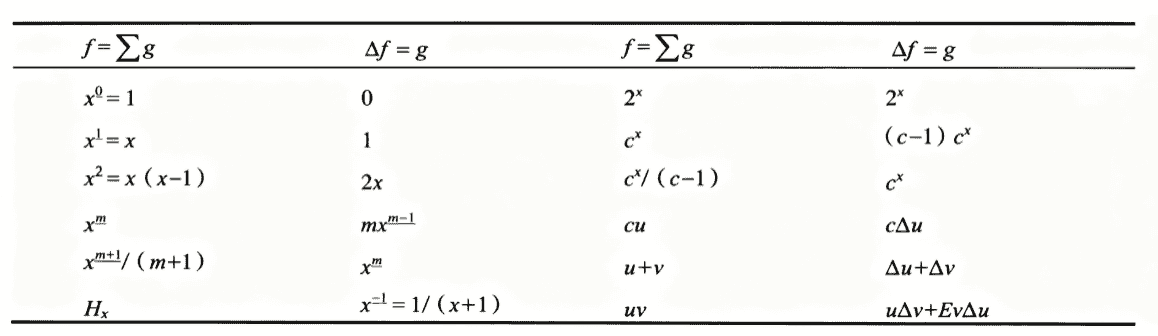
- is like in finite
- is like in finite
- is like in finite
So the whole calculation of is :
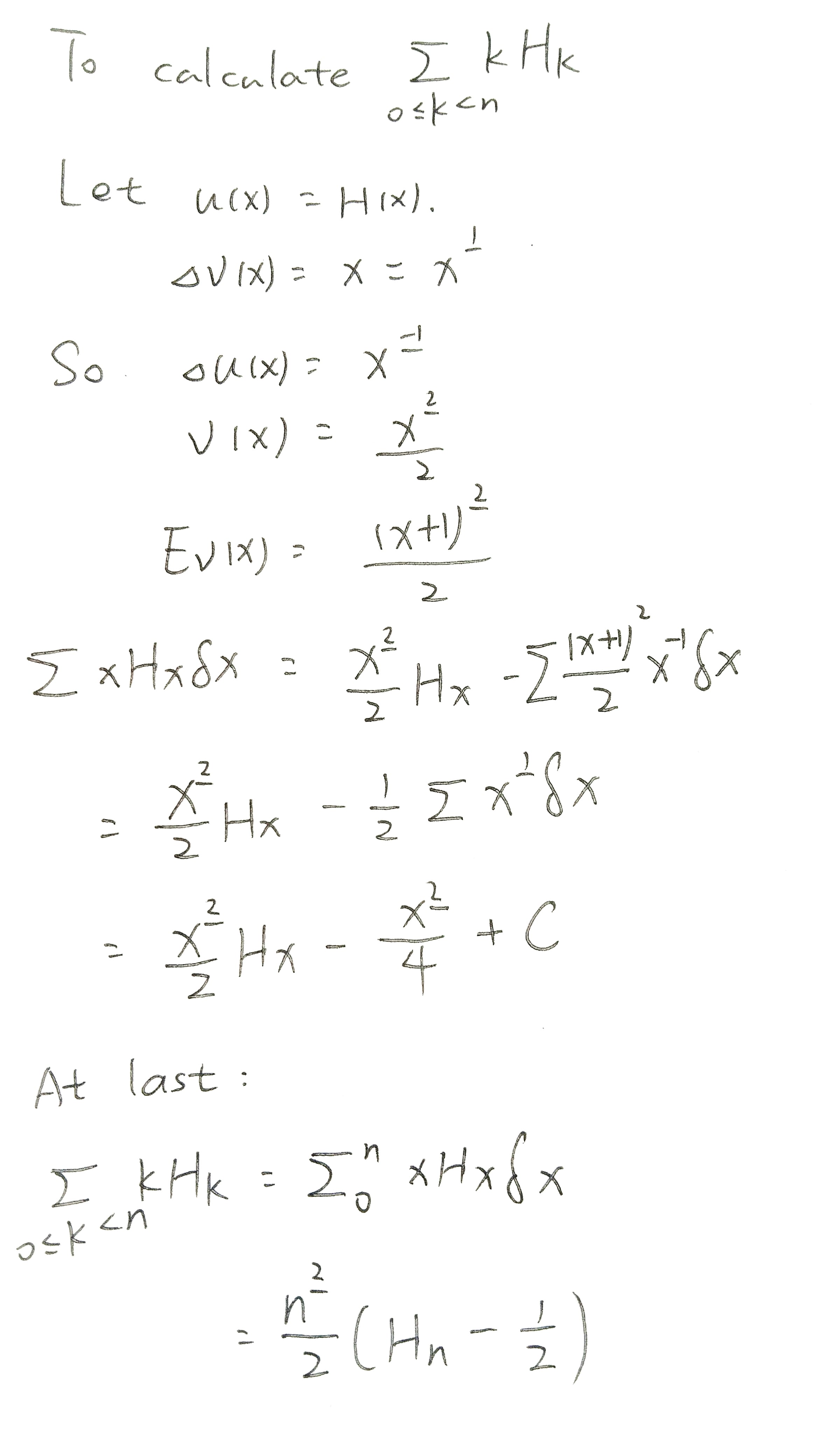
Here, . We refer to E as the shift operator.
Give you an example :
*English improve
And it must have to be->And it must satisfyOnly $D(n)$ is unknown, so we can get it easily !->Since only $D(n)$ remains unknown, we may solve for it directly !but we can change it->yet we may rewrite it asHere's->Below arewe called it->we refer to E as
本博客所有文章除特别声明外,均采用 CC BY-NC-SA 4.0 许可协议。转载请注明来源 zhangxixi的博客!
相关推荐

2023-09-03
线性求逆元
线性求逆元 本文搬运自本人高中时期CSDN博客,若图片加载不出来,可到原文查看:https://blog.csdn.net/zhangtingxiqwq/article/details/132650059 先暴力求出 1n!\frac 1 {n!}n!1 往回推出 1i!\frac 1 {i!}i!1 1i=(i−1)!i!\Large \frac 1 i=\frac{(i-1)!}{i!}i1=i!(i−1)!

2021-12-08
【HDU 7015 Another String】题解
本文搬运自本人初中博客园博客,若图片加载不出来,可到原文查看:https://www.cnblogs.com/zhangtingxi/p/15663221.html 题目链接 题目 Define the distance between two strings of the same length as the numbers of the positions where the characters differ in these two strings. If two strings of the same length has a distance of no more tha...

2021-11-24
【NOIP2021 方差】题解
本文搬运自本人初中博客园博客,若图片加载不出来,可到原文查看:https://www.cnblogs.com/zhangtingxi/p/15598937.html 题目链接 Part A 式子化简 首先题目要求的式子就是 n2n^2n2 乘上 1n∑i=1n(ai−aˉ)2\frac{1}{n}\sum_{i=1}^n(a_i-\bar a)^2n1∑i=1n(ai−aˉ)2,其中 aˉ=1n∑i=1nai\bar a=\frac{1}{n}\sum_{i=1}^n a_iaˉ=n1∑i=1nai。 我们把这三合在一起也就是: n2×1n∑i=1n(ai−1n∑j=1n...

2026-07-09
高等数学启蒙
高等数学启蒙 微分 f′(x)=dydxf'(x)=\dfrac {dy}{dx}f′(x)=dxdy 积:d(uv)dx=dudxv+dvdxu\dfrac{d(uv)}{dx}=\dfrac{du}{dx}v+\dfrac {dv}{dx}udxd(uv)=dxduv+dxdvu,即: d(uv)=du⋅v+dv⋅ud(uv)=du\cdot v+dv\cdot ud(uv)=du⋅v+dv⋅u 商同理: 不定积分 F(x)=∫f(x)dxF(x)=\int f(x)dxF(x)=∫f(x)dx,则 f(x)f(x)f(x) 的原函数是 F(x)F(x...

2022-07-28
【P3935 Calculating】题解
本文搬运自本人初中博客园博客,若图片加载不出来,可到原文查看:https://www.cnblogs.com/zhangtingxi/p/16529785.html 题目地址 题目 若 xxx 分解质因数结果为 x=p1k1p2k2⋯pnknx=p_1^{k_1}p_2^{k_2}\cdots p_n^{k_n}x=p1k1p2k2⋯pnkn,令f(x)=(k1+1)(k2+1)⋯(kn+1)f(x)=(k_1+1)(k_2+1)\cdots (k_n+1)f(x)=(k1+1)(k2+1)⋯(kn+1),求 ∑i=lrf(i)\sum_{i=l}^rf(i)∑i=...

2026-06-19
线性代数学习笔记(第 6- 10 课)
线性代数学习笔记(第 6- 10 课) 本文搬运自本人高中时期CSDN博客,若图片加载不出来,可到原文查看:https://blog.csdn.net/zhangtingxiqwq/article/details/162126613 线性代数学习笔记(6-10课) 第六课:分块矩阵 I 分块运算的规则 分块矩阵 运算规则 加法 乘法 前提: AAA 的列分发和 BBB 的行分法必须完全相同 II 分块对角阵的性质 定义:一个分块矩阵除了主对角线上的子块外,其余所有子块都是零矩阵 形式: 性质: 行列式等于对角块行列式之积 逆矩阵等于对角块逆矩阵的分...