
Gyroscope
Gyroscope
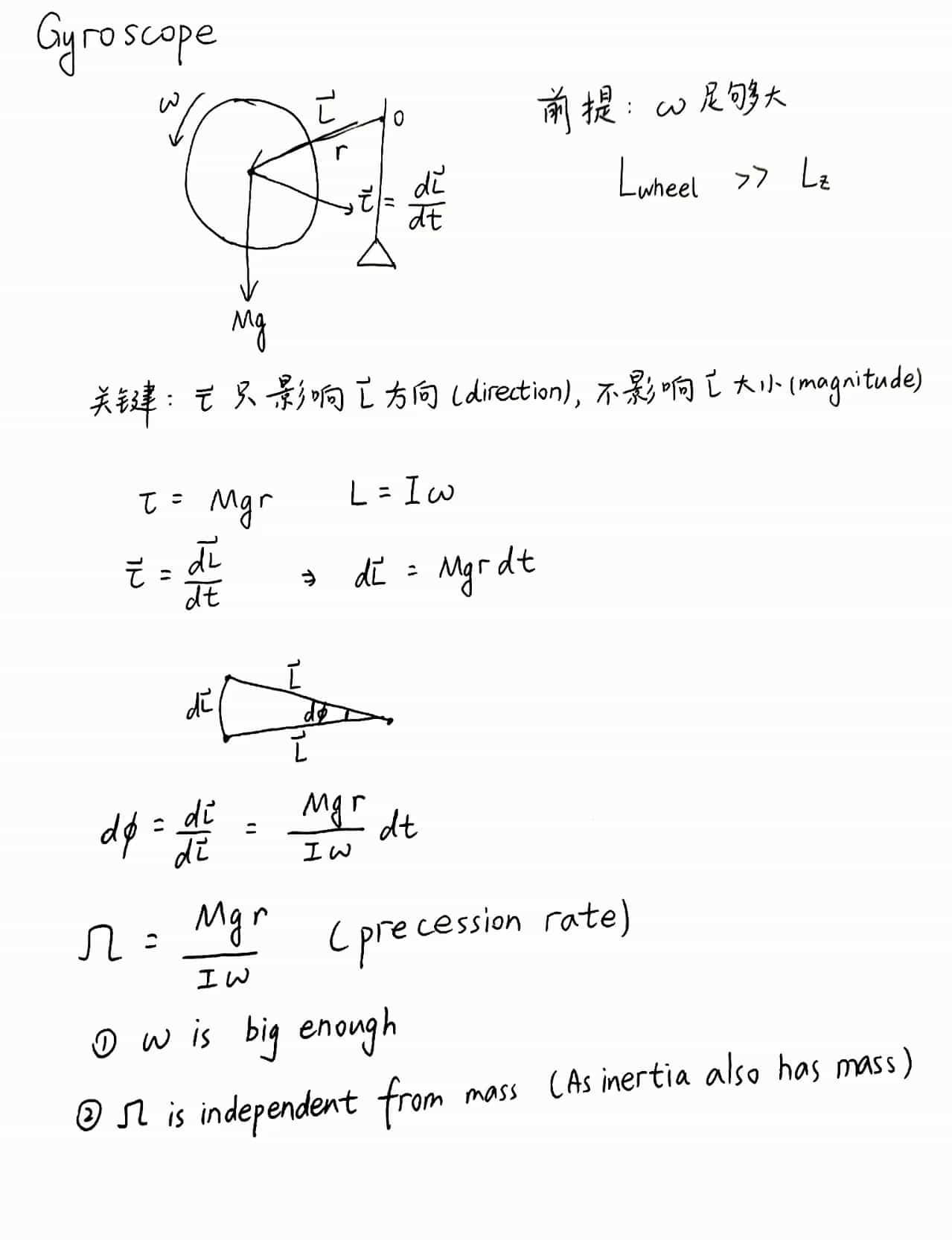
1. Premise and Key Insight
Premise:
- The angular velocity is sufficiently large.
- The spin angular momentum dominates: .
Key Insight:
The torque only affects the direction of the angular momentum , but it does not affect its magnitude.
2. Mathematical Derivation
The magnitude of the torque is given by:
The magnitude of the angular momentum is:
According to the rotational analog of Newton’s second law:
This implies that the change in angular momentum over a small time interval is:
Since the torque is perpendicular to the angular momentum, it causes the angular momentum vector to rotate by an infinitesimal angle without changing its magnitude. From the vector triangle formed by and :
Substituting the expressions for and :
3. Precession Rate
The precession rate (angular velocity of precession), denoted by , is the rate of change of the angle with respect to time:
Important Conditions and Remarks
- must be sufficiently large.
- is independent of mass . This is because the moment of inertia is also proportional to the mass, so the mass terms cancel out in the numerator and denominator.
本博客所有文章除特别声明外,均采用 CC BY-NC-SA 4.0 许可协议。转载请注明来源 zhangxixi的博客!
相关推荐
2026-10-14
Rotation and Rolling
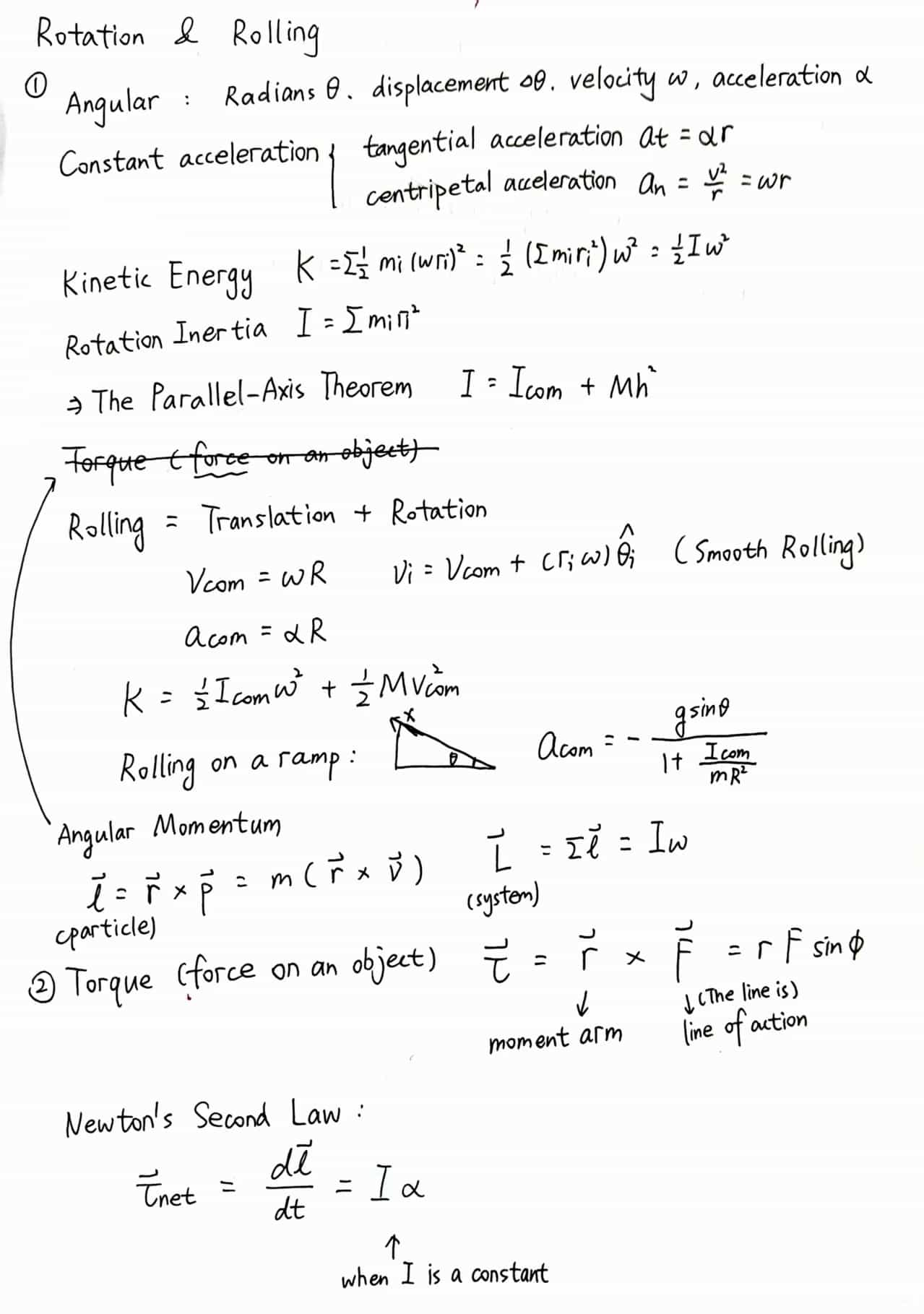
Rotation and Rolling Angular Kinematics Angular Variables: Radians: θ\thetaθ Displacement: Δθ\Delta\thetaΔθ Velocity: ω\omegaω Acceleration: α\alphaα Constant Acceleration For an object undergoing constant angular acceleration, the linear accelerations are: Tangential acceleration: at=αra...
2026-09-29
Honors Physics Chapter 10 - Rotation
Honors Physics Chapter 10 - Rotation Rotational Variables Radians (Rad) : θ=sr\theta =\dfrac s rθ=rs 1 rev=360°1\,\text{rev}=360\degree1rev=360° rev : revolutions Angular displacement : Δθ=θ2−θ1\Delta \theta = \theta_2-\theta_1Δθ=θ2−θ1 Counterclockwise direction is positive Average angu...