Honors Physics Chapter 10 - Rotation
Rotational Variables
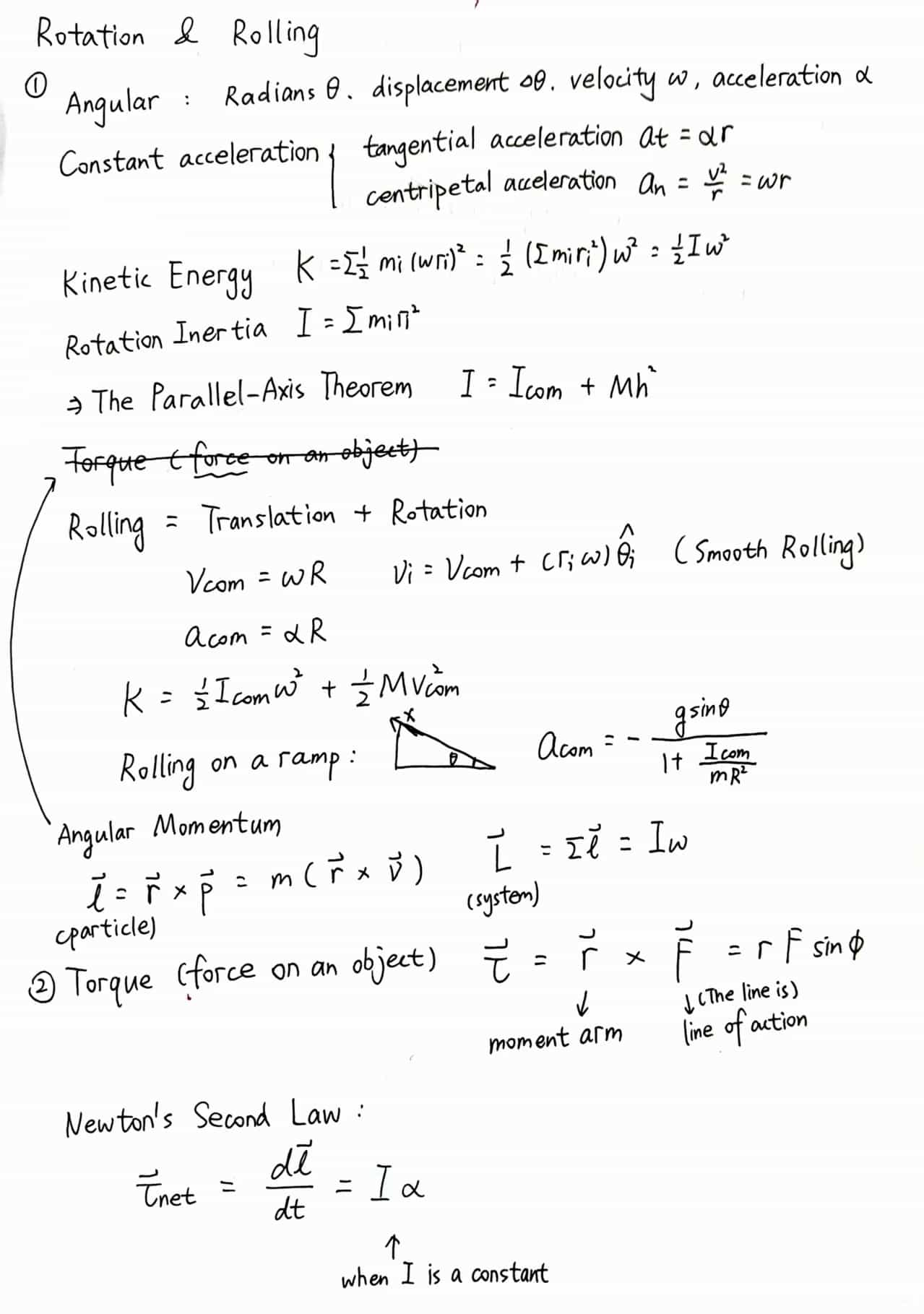
- Radians (Rad) : θ=rs
- 1rev=360° rev : revolutions
- Angular displacement :
- Δθ=θ2−θ1
- Counterclockwise direction is positive
- Average angular velocity
- Instantaneous angular velocity : ω=limΔt→0ΔtΔθ=dtdθ
- Average angular acceleration
- Instantaneous angular acceleration: α=limΔt→0ΔtΔω=dtdω
Angular displacement are not vectors, because the order of rotation matters for rotations around are not the same.
Rotation with Constant Angular Acceleration
- Tangential acceleration : at=αr
- Centripetal acceleration : an=rv2=ωr
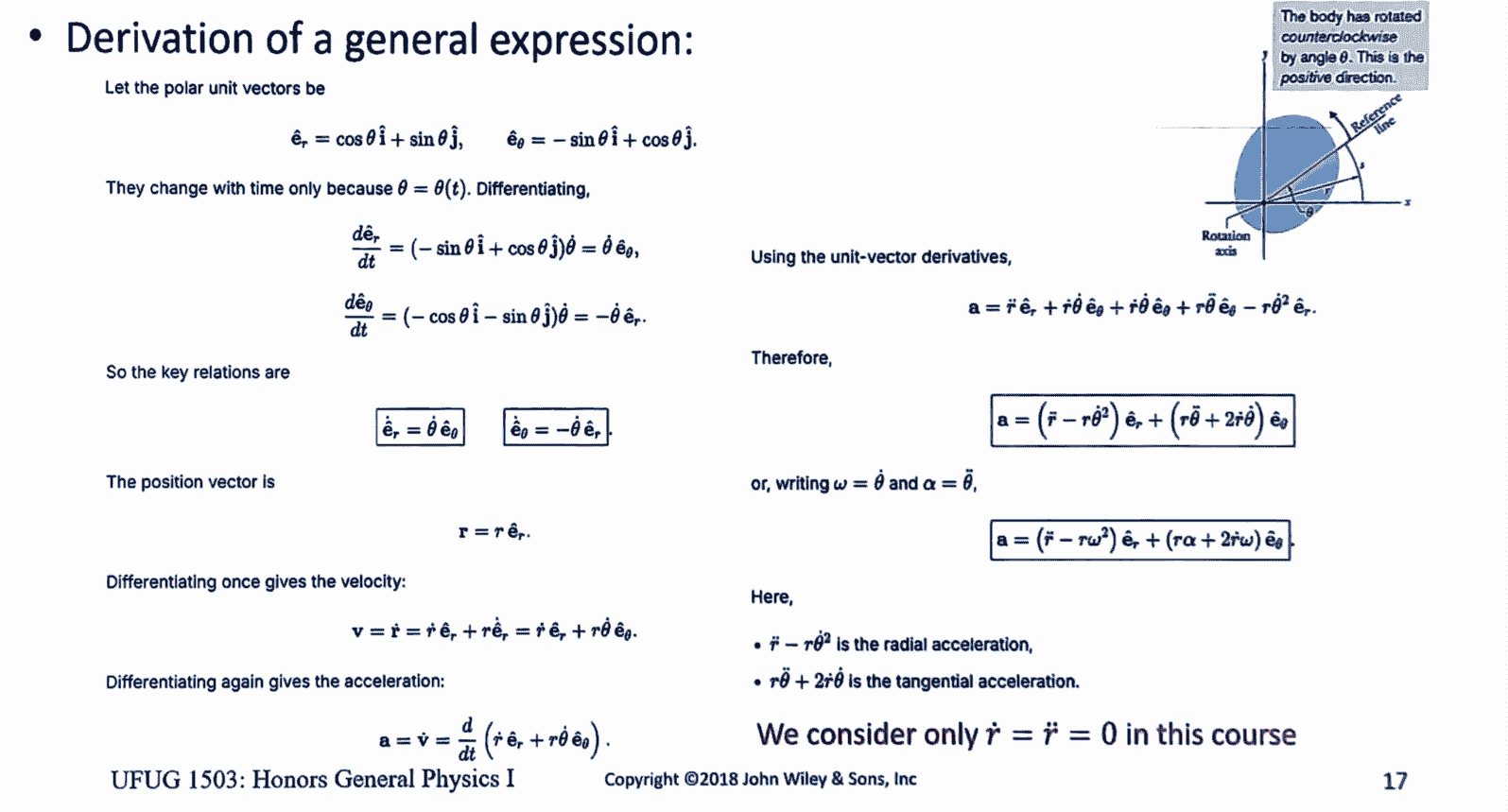
*Attachment :
r(t)=r(t)(cosθ(t),sinθ(t))=r(t)cosθ(t)x^+r(t)sinθ(t)y^v(t)=dtdr(t)=r˙(t)cosθ(t)+r(t)θ˙(t)(−sinθ(t))
Kinetic Energy of Rotation
K=∑21mi(ωri)2=21(∑miri2)ω2
The boxed area is called rotational inertia, or moment of inertia, I.
This is a constant for a rigid object and given rotational axis.
Caution : the axis for I must have to be specified.
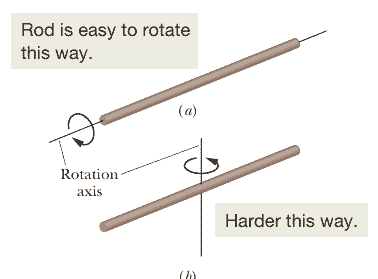
To sum up :
I=∑miri2
So we can rewrite the kinetic energy as :
K=21Iω2
For a discrete particles:
I=∫r2dm
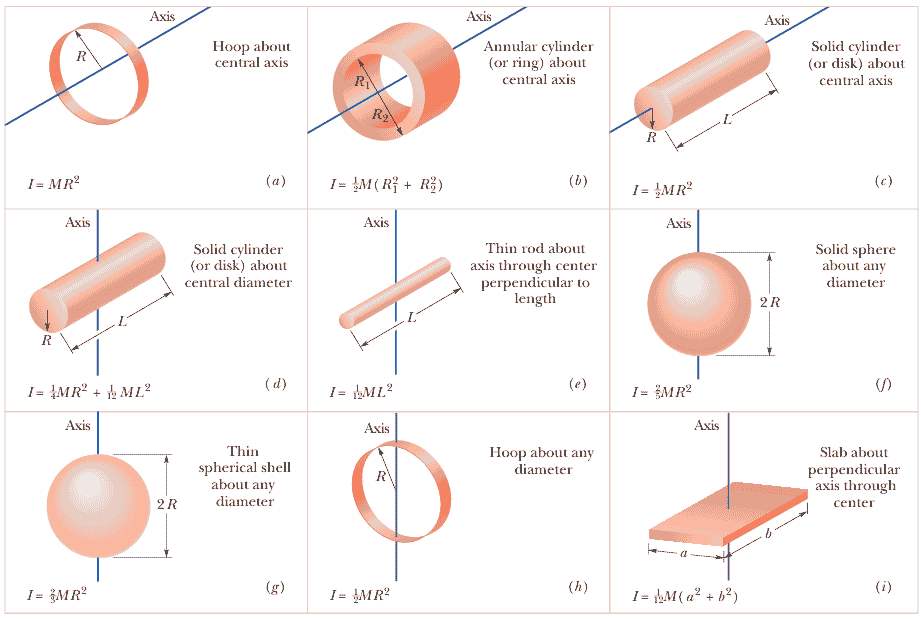
Some common:
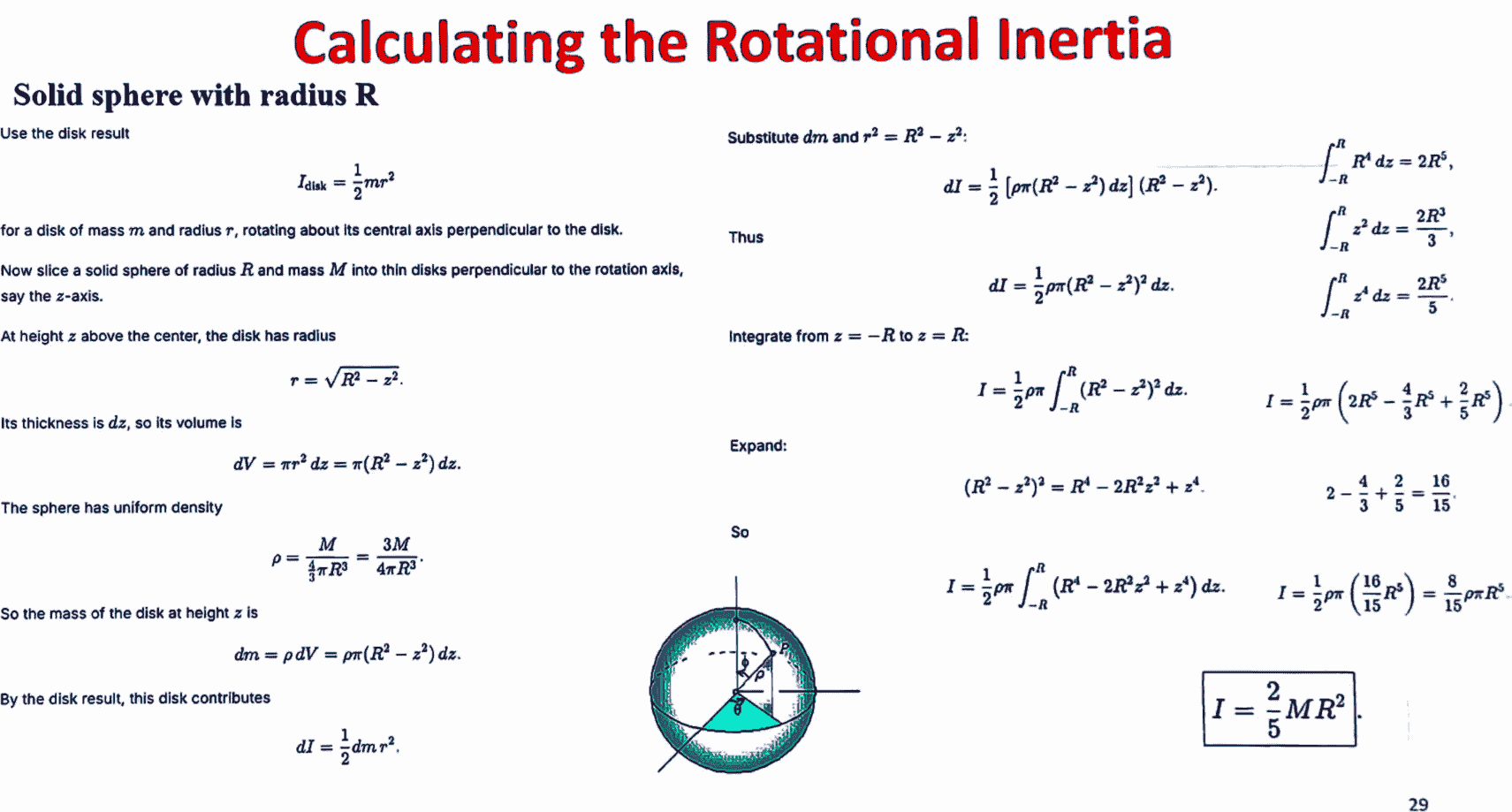
An example proof :
The Parallel-Axis Theorem
Assuming the rotation axis is deviated :
I=Icom+Mh2
Note the axis must be parallel.
Torque
τ=F⊥d=(r)(Fsinϕ)τ=r×F
Torque, τ.
The line is called the line of action of F.
The r=rsinϕ is called the moment arm.
The unit of torque is N⋅m, but torques are never expressed in joules, torque is not energy.
Torque is positive if it would cause a counterclockwise.
For several torques, the net torque or resultant torque is the sum of other torques.
Newton’s Second Law for Rotation
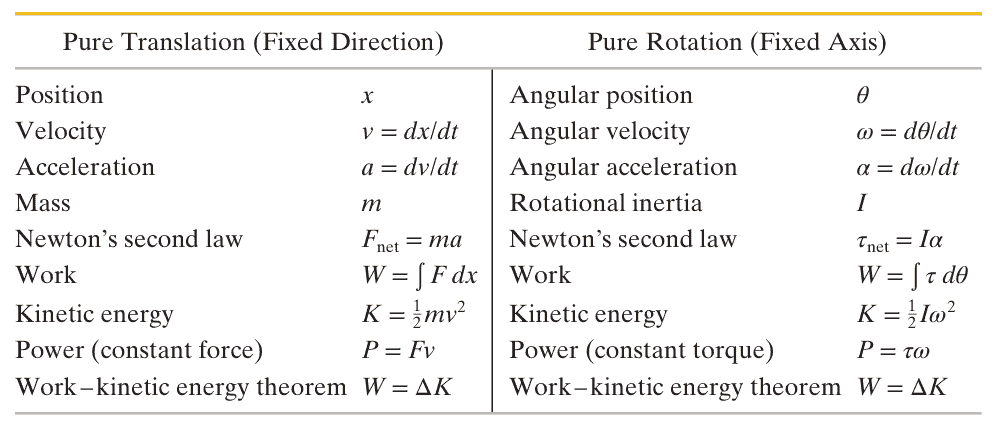
| Linear |
Angular |
| F |
τ=r×F |
| m |
I=∑miri2 |
| a |
α |
| v |
ω |
So:
τnet=Iα
It is torque that causes angular acceleration
α=Δt→limΔtΔω=dtdω
Work and Rotational Kinetic Energy
The rotational work-kinetic energy theorem states:
ΔK=Kf−Ki=21Iωf2−21Iωi2=W
The work done in a rotation about a fixed axis can be calculated by:
W=∫θiθfτdθτnet=Iα
For a constant torque, reduces to:
W=τ(θf−θi)
We can relate work to power with equation:
P=dtdW=τω