
状压dp + 最小割中inf双向单向变的捆绑决定技巧:ABC472G
状压dp + 最小割中inf双向单向变的捆绑决定技巧:ABC472G
法1:状压dp
首先本质上每一行都是可以抽象成连续段,连续段数量不超过15,所以每一维的状态可以直接存下来。
设 代表第 行的状态为 时,前 行的最大值。
显然对于一个固定的 ,可以很轻松求出下一行对应的 ,因此转移到 。
而现在考虑新的一行的内部,可以新增#段。也就是让 贡献到 dp[i+1][S\or 2^j] 中。
时间复杂度
1 |
|
法2: 最小割
我们可以发现一些性质:
- 如果一个点是空格,那样子它的左右必然是空格
- 如果一个点是空格,那么它的上面必然是空格
我们可以假设我们把所有的+都不变,所有的-都是#。
然后我们现在要开始反悔了。反悔是有代价的,所以我们考虑让这个代价最小。
我们考虑最小割。
所有点和S、T都相连。如果最终和S相连代表它不变,如果最终和T相连,代表变成#。
如果最后+和T相连,答案要-1,所以这个+和S这条边的权值是1。
-还是-的话,即和S相连,答案也要-1,这个-和T相连的权值也为1。
然后我们还要满足题目条件的限制:
- 若左右相邻,说明二者的状态必须一致,所以我们连inf的双向边
- 如果上下相邻,说明下是空地时,上一定也是空地,所以我们从下往上连一条inf的单向边
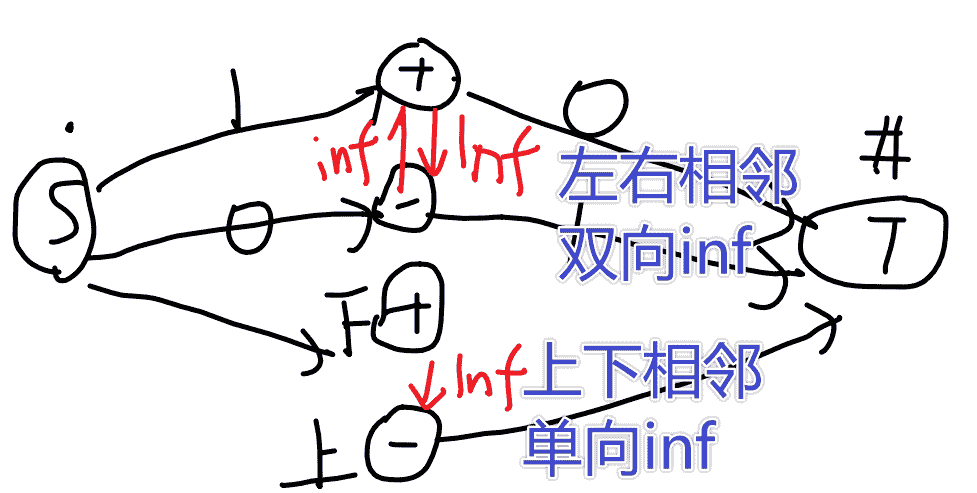
跑最小割即可。
1 |
|
本博客所有文章除特别声明外,均采用 CC BY-NC-SA 4.0 许可协议。转载请注明来源 zhangxixi的博客!
相关推荐

2023-12-19
考虑全选然后删的代价转最小割+最小割同一类连inf的边:AT_arc107_f
考虑全选然后删的代价转最小割+最小割同一类连inf的边:AT_arc107_f 本文搬运自本人高中时期CSDN博客,若图片加载不出来,可到原文查看:https://blog.csdn.net/zhangtingxiqwq/article/details/135093630 https://www.luogu.com.cn/problem/AT_arc107_f 理论上界为 ∑∣bi∣\sum |b_i|∑∣bi∣ 。考虑现在减少会有什么情况: 不选。代价为 ai+∣bi∣a_i+|b_i|ai+∣bi∣ 原先为正,所在连通块取绝对值后变负。代价为 −2∣bi∣-2|b_...

2023-12-02
最小割构造
最小割构造 本文搬运自本人高中时期CSDN博客,若图片加载不出来,可到原文查看:https://blog.csdn.net/zhangtingxiqwq/article/details/134750195 考虑跑完最大流,我们再从源点跑一遍bfs,所以能跑到的点都属于点集A,否则属于点集B
2026-09-11
根号分治 + NTT优化dp转移:ICPC2026网络赛B
根号分治 + NTT优化dp转移:ICPC2026网络赛B 考虑一个朴素的dp 定义 cic_ici 表示有多少个 aaa 小于等于 iii。显然 iii 只有模这 cic_ici 个数才会改变。 设 fif_ifi 表示在整个过程中,有多少种排列使得 iii 存在过。显然对于 i<a1i<a_1i<a1,fif_ifi 就是答案。而 i≥a1i\ge a_1i≥a1,答案是0。 fi×1ci→j∈{a}fi mod jf_i\times \frac 1{c_i}\to_{j\in \{a\}}f_{i\,\bmod\, j} fi×ci1→j∈...
2023-10-06
充分理清限制与条件+构造二分图+最小割:ARC142E
充分理清限制与条件+构造二分图+最小割:ARC142E 本文搬运自本人高中时期CSDN博客,若图片加载不出来,可到原文查看:https://blog.csdn.net/zhangtingxiqwq/article/details/133623334 https://www.luogu.com.cn/problem/AT_arc142_e 他的充要条件是是什么: ai,aj≥min(bi,bj)a_i,a_j\ge min(b_i,b_j)ai,aj≥min(bi,bj) 存在 ai≥max(bi,bj)a_i\ge max(b_i,b_j)ai≥max(bi,b...

2023-12-20
平面图转对偶图 + 平面图上最小割转对偶图上最短路
平面图转对偶图 + 平面图上最小割转对偶图上最短路 本文搬运自本人高中时期CSDN博客,若图片加载不出来,可到原文查看:https://blog.csdn.net/zhangtingxiqwq/article/details/135111564 如上图所示,有一个平面图,有很多点组成,每个接触线有一个权值。我们可以把平面图转成对偶图。我们在 (s,t)(s,t)(s,t) 之间画一条直线,把外面分成两个面。我们把每个面视为一个点。如果两个面有接触线,他们就连一条边,边的边权,就是接触线的边权。 在上图上,如如果我们想求 s→ts\to ts→t 的最大流,根据最大流 = 最小割,我...

2023-12-11
1211T2:分层图跑最小割(要割几次的最小割)
1211T2:分层图跑最小割(要割几次的最小割) 本文搬运自本人高中时期CSDN博客,若图片加载不出来,可到原文查看:https://blog.csdn.net/zhangtingxiqwq/article/details/134926699 http://47.92.197.167:5283/contest/437/problem/2 k=1k=1k=1 就是个最小割 发现我们可能要割很多次,我们可以直接建分层图,在分层图上完成