
Symbolic reasoning
Symbolic reasoning
PL
PL : Propositional Logic
Atom :
- truth symbols : True; False
- propositional varaibles
Literal : atom and
Formula (logical connective)
- not :
- and : conjunction \and
- or : disjunction \or
- implies : implication
- if and only if (iff):
Syntax does not tell us the interpret of formula
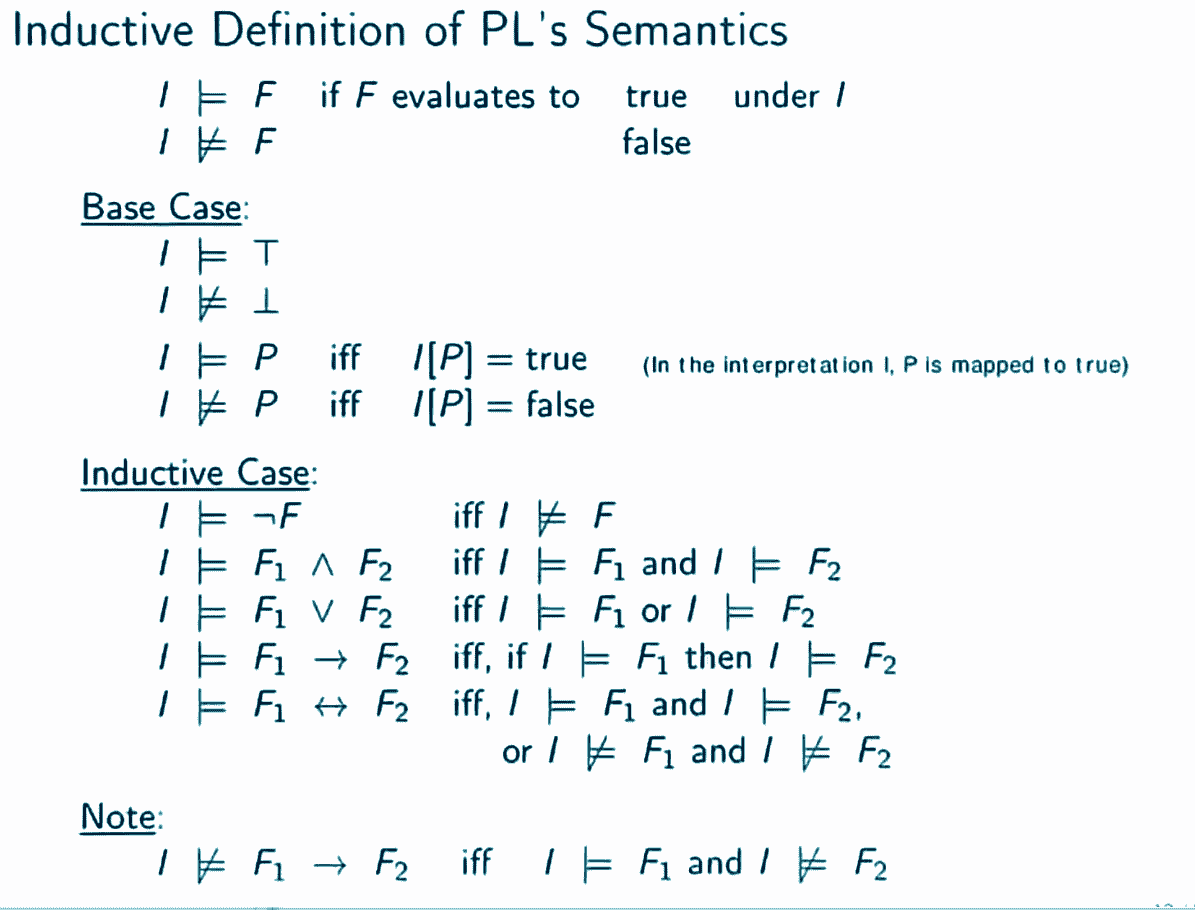
Interpretation: mapping
Model:
- : if evaluates to true under
Satisfiability and Validity
is satisfiable iff there exists an interpretation such that
is valid iff all interpretations ,
Important relation:
is valid iff is unsatisfiable
Truth Table
Satisfiability and Validity Checking : Method : Truth Tables
A proof method is sound if every formula that is proved true is valid
A proof method is complete if every valid formula has a proof
The truth table method for PL is sound and complete.
Decidability of PL
PL is decidable
There exists a method that can tell whether any formula in PL is valid (satisfiable)
The method is guarantee to halt within finite steps.
Not every logic is decidable.
Equivalence and Semantic Consequence
and is equivalent () iff:
entails : :
Translation to Formulas in Normal Forms
BNF : Backus Naor Form
NNF (Negation Normal Form) :
- Eliminate Implication and bi-implication
F_1\to F_2\equiv \neg F_1\or F_2
F_1\leftrightarrow F_2=(F_1\to F_2)\and(F_2\to F_1)
- Eliminate (double) negation
DNF (Disjunctive Normal Form) :
\Large{\or}_i\Large{\and}_j l_{i,j}
Final form is like : (\and\and)\or(\and \and)\or(\and)
CNF (Conjunctive Normal Form)
If clause has 1 literal is called unit clause

Tseitin Encoding :
Example :
(P_1\and P_2\cdots P_n)\or(Q_1\and Q_2\and\cdots Q_m)\equiv (P_1\or Q_1)\and(P_1\or Q_2)\and\cdots\and(P_n\or Q_m)
How many clauses in total do you have.
But we can solve it to