
期望 + dp + 计数 + 策略转限制:ICPC2025沈阳E
期望 + dp + 计数 + 策略转限制:ICPC2025沈阳E
Play It by Ear - Problem - QOJ.ac
令 表示编号为 的牌在原先牌堆的位置。
设 表示完成第 步( 牌打出),至少需要多少步。设对于 这张牌,上一次出现在 的位置,那样子有:
因为上一张牌打完之后至少要 轮后才能回到手中,再经过一轮才能打出来。
当然,如果这张牌是第一次出现,那也必须满足:,你要先拿到手里,然后再打出。
那么总共需要的轮数是 。
这种一定能达到吗?我们考虑这个策略:
- 如果有需要的,立刻打
- 否则,打最晚需要的那一张。但至少目前手上有 张,还有1张不需要的要等。因此当前打出来这张至少在 轮后才需要,因此完全来得及。
我们要求 的期望值,我们设为 ,那么我们可以先考虑对于每个 有多少种合法的初始牌堆满足。那样子我们是能求出 的上界,而求 上界的过程相当于解很多具有有序性的不等式,我们要满足最严格的限制,那就反向跑个最长路即可(其实就是一个链状DAG上dp)
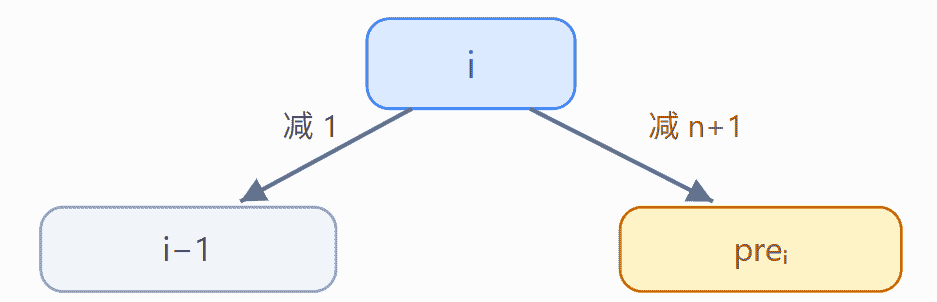
考虑我们求出从 到每个位置的最长路 ,然后假设对于牌 ,第一次在 的地方出现,那就要满足:
令 代表 的上界,注意 还要和 取min。
接下来就简单了,对 排序,然后得到 ,那样子期望步数小于等于 的方案为:
接下来对 做一个差分即可。
可以发现,有效的 的取值至多 个(实际上是 个)。 的最小有效值是 ,代入 ,也就是 增加 次之后必然达到 了。
还有,我们不可能每次都对 排序一遍,但可以发现 的顺序是不变的,所以提前排一次就行了。
时间复杂度
1 |
|
本博客所有文章除特别声明外,均采用 CC BY-NC-SA 4.0 许可协议。转载请注明来源 zhangxixi的博客!
相关推荐
2023-09-18
对于每种情况分别统计概率来计算期望+树上连通块统计:ARC165E
对于每种情况分别统计概率来计算期望+树上连通块统计:ARC165E 本文搬运自本人高中时期CSDN博客,若图片加载不出来,可到原文查看:https://blog.csdn.net/zhangtingxiqwq/article/details/132971902 https://atcoder.jp/contests/arc165/tasks/arc165_e 考虑一个常见套路,我们对每个连通块统计其概率,设为 p(T)p(T)p(T) ,则答案为 ∑∣T∣>kp(T)\sum_{|T|>k} p(T) ∣T∣>k∑p(T) 可以想成对于每个大小大于 kkk 的连...

2021-11-14
【洛谷P6835 [Cnoi2020]线形生物】题解
本文搬运自本人初中博客园博客,若图片加载不出来,可到原文查看:https://www.cnblogs.com/zhangtingxi/p/15552685.html 题目链接 明显是道期望dp,设 fi=Ei→i+1f_i=E_{i\rightarrow i+1}fi=Ei→i+1。表示从第 iii 层到第 i+1i+1i+1 层的期望步数。 所以 Ex→y=∑i=xyfiE_{x\rightarrow y}=\sum_{i=x}^yfiEx→y=∑i=xyfi,即从第 xxx 层走到第 yyy 层的总期望步数。 现在推 fxf_xfx, 设 dxd_xdx 为 xxx ...

2023-09-13
善于运用期望可加性+维护增量+DAG上DP:0912T4
善于运用期望可加性+维护增量+DAG上dp:0912T4 本文搬运自本人高中时期CSDN博客,若图片加载不出来,可到原文查看:https://blog.csdn.net/zhangtingxiqwq/article/details/132857701 CP0912T4 首先看到无环,也就是DAG,显然拓扑 然后看到题目求类似期望和砍边的东西,就要考虑dp 然后有两个Trick 期望具有可加性 对于只有一次的操作,考虑增量 好了,现在我们考虑增量,假设已经知道不操作的答案,现在求恰好操作一次的增量 然后可以手玩一下,发现哪些边对哪些点会有哪些影响。 然后加起来就行了 ...

2023-09-27
博弈论(奇偶考虑法)+计数+DP(判定转DP):CF838C
博弈论(奇偶考虑法)+计数+DP(判定转dp):CF838C 本文搬运自本人高中时期CSDN博客,若图片加载不出来,可到原文查看:https://blog.csdn.net/zhangtingxiqwq/article/details/133362167 首先题目有博弈,先分析一波最优策略(步骤:分析性质)。 两个人,所以显然考虑奇偶考虑法+递归考虑。 首先删就是使子问题-1,重新排列是在当前子问题里的。 一个串的排列是有限的,所以这里就可以上奇偶考虑法。如果有偶数种串,则必然是后手先“被迫“进入子问题(要算上初始情况) 考虑假设法:我们可以先假设进入子问题: 必赢。先手进! ...

2023-12-02
贪心+计数:CF1612G
贪心+计数:CF1612G 本文搬运自本人高中时期CSDN博客,若图片加载不出来,可到原文查看:https://blog.csdn.net/zhangtingxiqwq/article/details/134747631 https://www.luogu.com.cn/problem/CF1612G 贪心考虑如何放最优。 假设当前出现次数最多为 iii ,有 kkk 个这样的数,打表可得左边 kkk 个随便放,右边 kkk 个随便放,然后递归下去即可,当前层方案数为 (k!)2(k!)^2(k!)2 。 在这个过程中顺便维护最大值即可。 123456789101112 m=read...

2023-11-14
枚举连通块拆贡献+容斥:ABC321G
枚举连通块拆贡献+容斥:ABC321G 本文搬运自本人高中时期CSDN博客,若图片加载不出来,可到原文查看:https://blog.csdn.net/zhangtingxiqwq/article/details/133266690 https://atcoder.jp/contests/abc321/tasks/abc321_g 这种题都没看出来我要去退役了 看完题目,可以获得: 期望、连通块:显然拆贡献啊! n≤17n\le 17n≤17 :这不明显状压?结合前面连通块,就是枚举连通块啊! 继续分析第2点,17这么小,显然枚举子集。为啥枚举?计数题只有容斥这个套路啊!...