
树上优先队列维护贪心:2026暑杭电多校 1-04 搭积木
树上优先队列维护贪心:2026暑杭电多校 1004 搭积木
感觉这个套路还是非常非常经典的,不知道我为什么忘了,还好队友带飞了。
我们考虑两棵子树 分别连到一个大的连通块上,先连谁,推一推式子可以发现,如果先 后 ,则:
移项得:
所以这就很明显了,我们可以按 进行排序。
由于这在树上,就变成了一个很经典的转化,我们直接用优先队列来维护上面这个式子。然后一个个加入维护,后面这个就显然了。
1 |
|
本博客所有文章除特别声明外,均采用 CC BY-NC-SA 4.0 许可协议。转载请注明来源 zhangxixi的博客!
相关推荐
2021-12-02
【[ARC063C] Integers on a Tree】
本文搬运自本人初中博客园博客,若图片加载不出来,可到原文查看:https://www.cnblogs.com/zhangtingxi/p/15633812.html 题目链接 对于最小的点,与它相连的没填的点中,都赋值为这个点点权+1。 这样子贪心就算旁边的点必然会比这个点大,所以+1是没错的。 最后再遍历所有边检验答案合法性。 Code 1234567891011121314151617181920212223242526272829303132333435363738394041424344454647484950515253545556575859606162636465666...
2023-11-09
类直径树上贪心
类直径树上贪心 本文搬运自本人高中时期CSDN博客,若图片加载不出来,可到原文查看:https://blog.csdn.net/zhangtingxiqwq/article/details/134317828 http://cplusoj.com/d/senior/p/SS231109C 场上想到枚举点,然后最大值为高,然后可以求最大值。但是感觉计数会重 计数其实不会重,如图中,红色线段显然比蓝色线段优 所以我们枚举3叉点时没错的 123456789101112131415161718192021222324252627282930313233343536373839404142...

2022-05-13
【一本通 1488:新的开始】题解
本文搬运自本人初中博客园博客,若图片加载不出来,可到原文查看:https://www.cnblogs.com/zhangtingxi/p/16267581.html 题目链接 题目 发展采矿业当然首先得有矿井,小 FF 花了上次探险获得的千分之一的财富请人在岛上挖了 nnn 口矿井,但他似乎忘记考虑的矿井供电问题…… 为了保证电力的供应,小 FF 想到了两种办法: 在这一口矿井上建立一个发电站,费用为 vvv(发电站的输出功率可以供给任意多个矿井)。 将这口矿井与另外的已经有电力供应的矿井之间建立电网,费用为 ppp。 小 FF 希望身为「NewBe_One」计划首席工程师的你帮他想...

2023-11-01
树上贪心类——子树之和 / 新贡献:1031T1
树上贪心类——子树之和 / 新贡献:1031T1 本文搬运自本人高中时期CSDN博客,若图片加载不出来,可到原文查看:https://blog.csdn.net/zhangtingxiqwq/article/details/134170718 http://cplusoj.com/d/senior/p/SS231031A 可以发现从上面打下来,我们有两种对策: 直接引一条上来 下面每条分别对付 我们直接按照这种方法维护一个类似树形dp的东西就行了 123456789101112131415161718192021222324252627282930313233343536...
2023-11-08
树上移动类贪心:1108T4 / CF1381D
树上移动类贪心:1108T4 / CF1381D 本文搬运自本人高中时期CSDN博客,若图片加载不出来,可到原文查看:https://blog.csdn.net/zhangtingxiqwq/article/details/134297045 http://47.92.197.167:5283/contest/428/problem/4 我们定义关键点为有3条路径大于 ≥L\ge L≥L 的点。 如果其中一个点可以到达关键点,那么就可行。这是一个充要条件。 我们以关键点为根,如果某个时刻两个点一个是另一个是父亲,那么一定可以开到关键点那里。 我们只需要两个端点轮流往他们子树最深处的地...
2026-10-05
整除分块 + 哈夫曼树优化:CCPC2026网络赛L
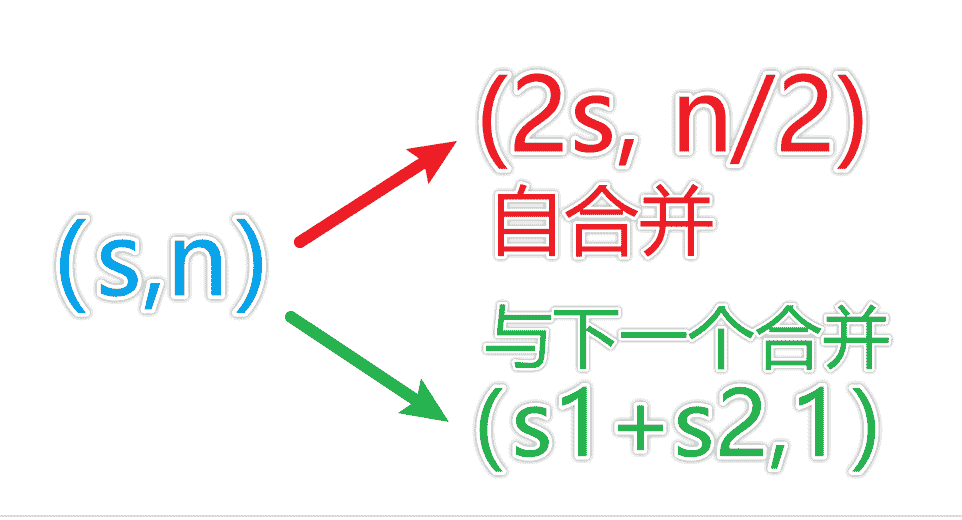
整除分块 + 哈夫曼树优化:CCPC2026网络赛L Logging Compression - Problem - QOJ.ac 这题其实就是让你实现哈夫曼树。 我们首先考虑压缩信息。如果一段区间每个数出现是相同的,我们就可以合并来存储他们。那样子在优先队列里我们记两个值:当前值 sss + 有多少个数是这样的 nnn。 我们考虑我们在小根堆里取出来的第一个东西,其 n≥2n\ge 2n≥2,那样子其实本质上有 $\lfloor\dfrac n 2\rfloor $ 对自己和自己合并。那我们直接把 (2s,⌊n2⌋)(2s,\lfloor\dfrac n 2\rfloor )(2s,⌊...