
Honors Calculus I - 2.3 Continuity
Honors Calculus I - 2.3 Continuity
Continuous Functions
is said to be continuous at if
definition:
For every , there exists a such that satisfy
- Left-continuous :
- Right-continuous:
A function is continuous at iff it is both left-continuous and right-continuous at .
- If is continuous at every point in , then is said to be continuous on
- If is continuous at every point in , and is right-continuous at and left-continuous at , then is said to be continuous on
Operations on continuous functions
- Suppose and are continuous functions on , then are continuous on (for quotient, the denominator is not zero)
- If is continuous at a point and is continuous at the point , then the composite of is continuous at
Properties of Continuous Functions
Extreme Value Theorem
Suppose is a continuous functions on a bounded closed interval , then exists such that:
Intermediate Value Theorem
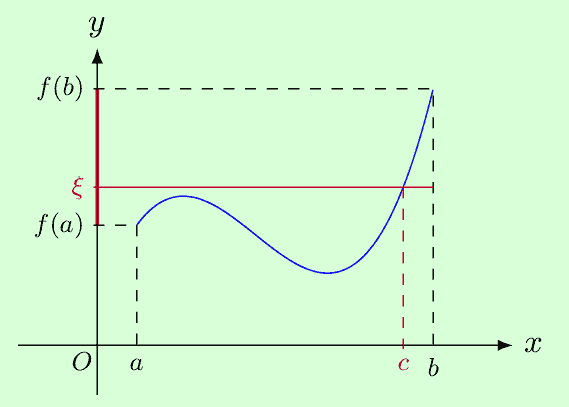
Suppose is continuous on , for any value between and , there exists at least one point such that .
One can modify the Intermediate Value Theorem to:
Any real-valued continuous function on attains all intermediate values between and .
Bolzano’s Theorem:
Any real continuous function on has at least one root if .
Continuity of the inverse function
What is inverse? It must be bijective.
For a continuous interval:
A continuous function on an interval is invertible iff it is strictly monotonic.
If is strictly increasing and continuous, then is invertible, and its inverse is also strictly increasing and continuous. (The same holds if is strictly decreasing and continuous)
Uniform Continuity
is uniformly continuity on if:
If a function is uniformly continuity, is must be continuity (but the inverse is not true)
(Continuity is a pointwise property, whereas uniform continuity pertains to a whole set)
Note that the only depends on , not or .
Theorem: Relationship between continuity and uniform continuity
Every continuous functions defined on a bounded closed interval is uniformly continuous on that interval.