[Chapter 1 Summary] of Linear Algebra
[Chapter 1 Summary] of Linear Algebra
Here is Summary by AI
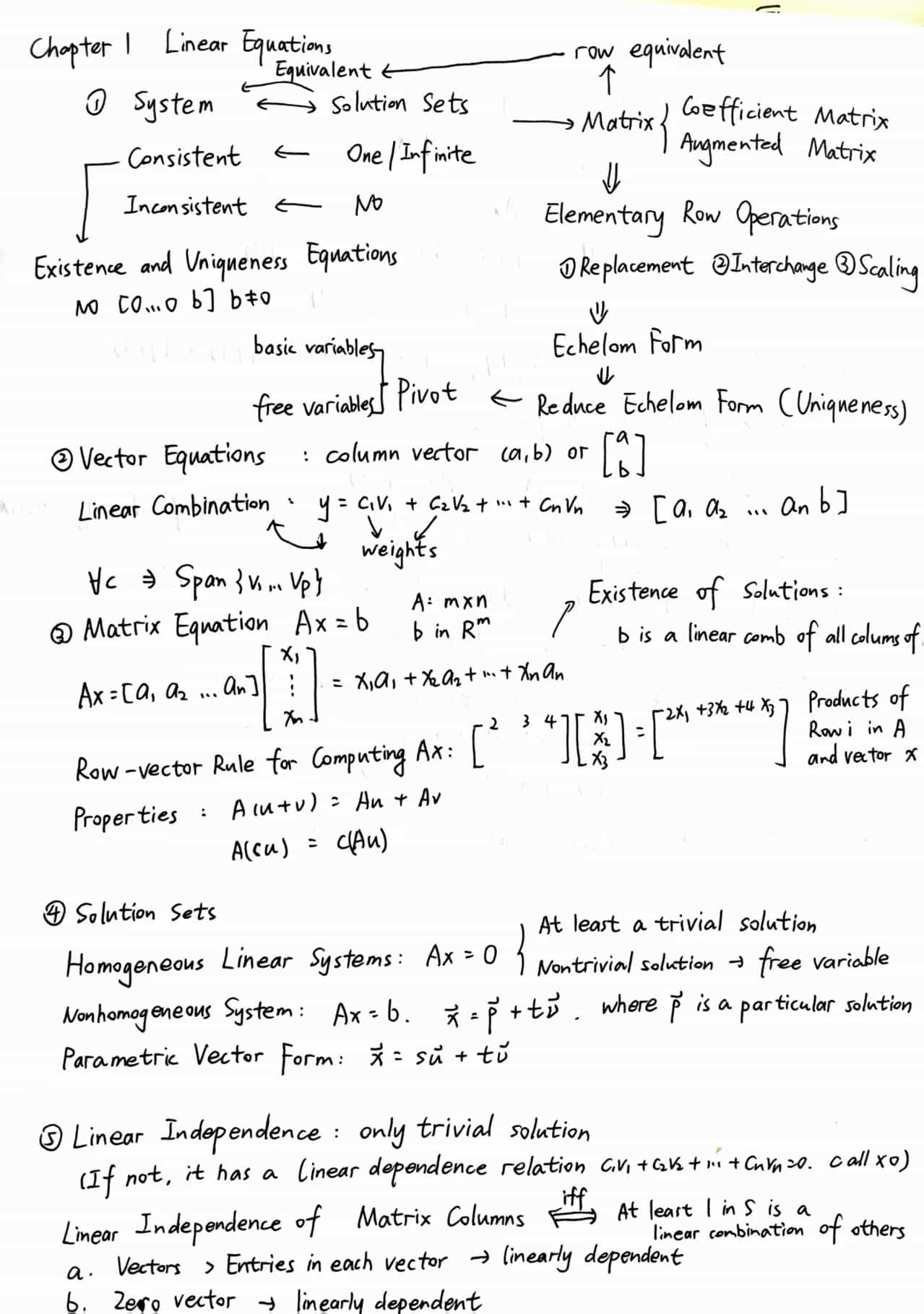
Chapter 1: Linear Equations
1. Systems of Linear Equations
- Equivalence: System Solution Sets Row equivalent.
- Consistency:
- Consistent One solution / Infinite solutions.
- Inconsistent No solution.
- Matrix Representations:
- Coefficient Matrix
- Augmented Matrix
1.1 Row Reduction & Existence
- Elementary Row Operations: (1) Replacement, (2) Interchange, (3) Scaling.
- Forms: Echelon Form Reduced Echelon Form (Uniqueness).
- Existence and Uniqueness:
- No solution if the system contains a row like where .
- Pivot determines basic variables and free variables.
- Free variables imply infinite solutions (uniqueness fails).
2. Vector Equations
- Notation: Column vector or .
- Linear Combination: , where are the weights.
- Span: .
3. Matrix Equation
- Form: , where is an matrix and .
- Existence of Solutions: is a linear combination of all columns of .
- Row-vector Rule for Computing : Products of Row in and vector .
- Properties:
4. Solution Sets
4.1 Homogeneous Systems ()
- At least a trivial solution exists.
- Nontrivial solution free variable exists.
4.2 Nonhomogeneous Systems ()
- General solution form: , where is a particular solution.
- Parametric Vector Form: .
5. Linear Independence
- Definition: Only trivial solution exists. If not, it has a linear dependence relation (where not all zero).
- Matrix Columns: Linear Independence of Matrix Columns At least 1 in is a linear combination of others.
- Rules of Thumb:
- Vectors > Entries in each vector linearly dependent.
- Zero vector linearly dependent.
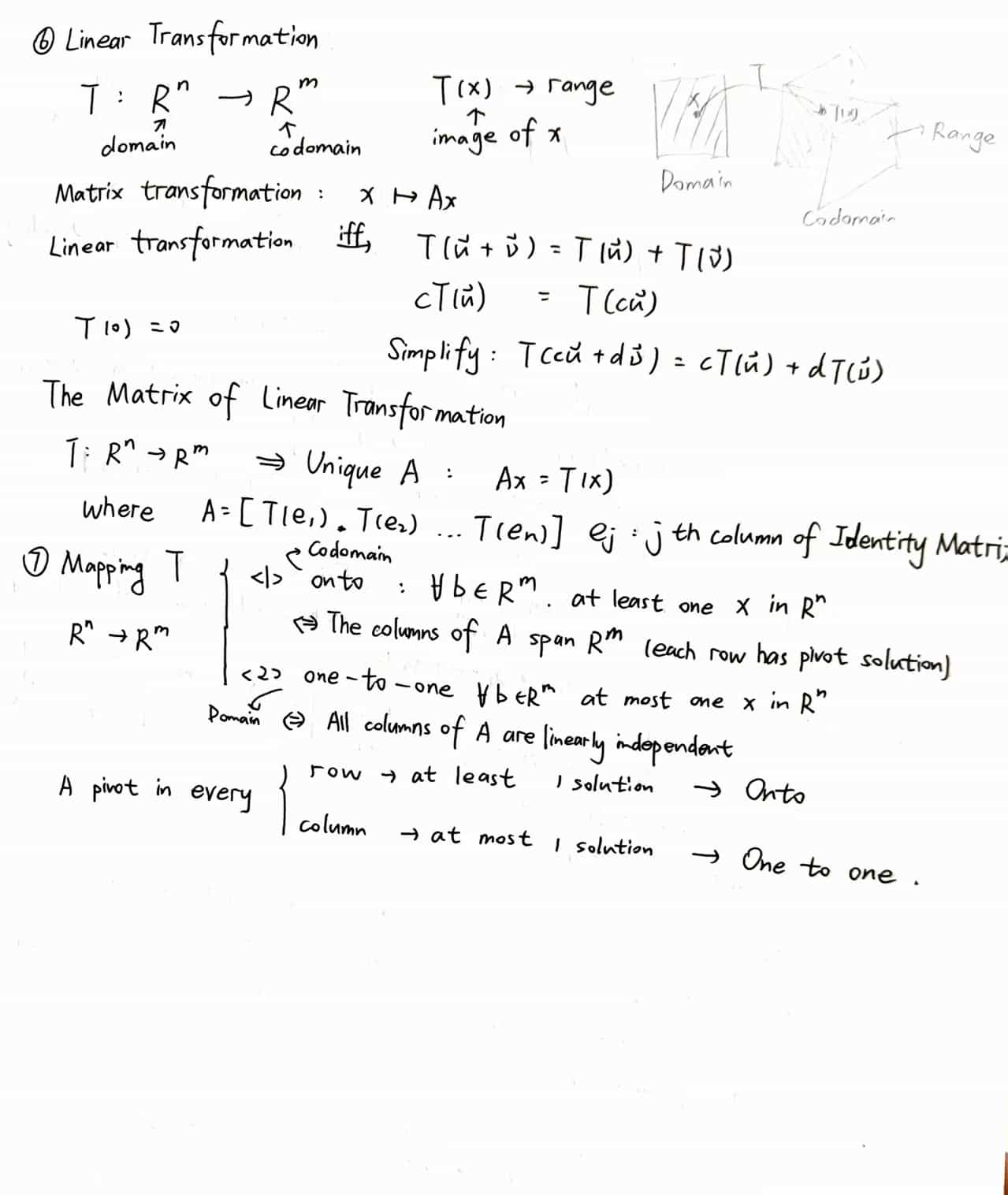
Linear Transformation
1. Introduction to Linear Transformations
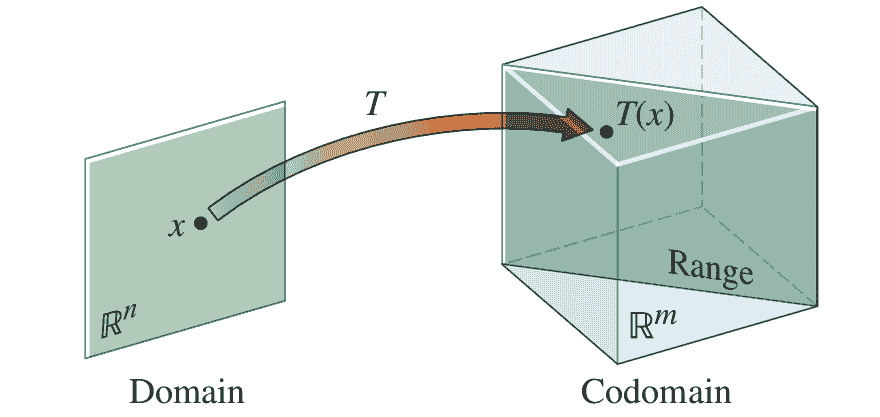
- Mapping Notation:
- Domain Codomain
- Range (Image of )
- Matrix Transformation: .
- Conditions for Linear Transformation (iff):
- Implication:
- Simplified Form:
2. The Matrix of a Linear Transformation
- Unique .
- Standard Matrix: , where is the -th column of the Identity Matrix.
3. Mapping Properties (Onto & One-to-one)
Mapping can be classified as follows:
| Property | Definition | Matrix Condition |
|---|---|---|
| Onto (Codomain) | , at least one in | The columns of span (each row has a pivot solution) |
| One-to-one (Domain) | , at most one in | All columns of are linearly independent (each column has a pivot) |
Pivot Summary
A pivot in every:
本博客所有文章除特别声明外,均采用 CC BY-NC-SA 4.0 许可协议。转载请注明来源 zhangxixi的博客!