
Linear Algebra - Chapter 3 Determinants
Linear Algebra - Chapter 3 Determinants
Section 3.1 Introduction to Determinants
Definition:
-
For :
-
For , we have a recursive definition:
where is a submatrix of that delete the first row and th column. (We called a minor)
Let:
The is called the - cofactor of .
Then
This formula is called a cofactor expansion across the first row of
Theorem 1 :
The determinant of an matrix can be computed by a cofactor expansion across any row or down any column.
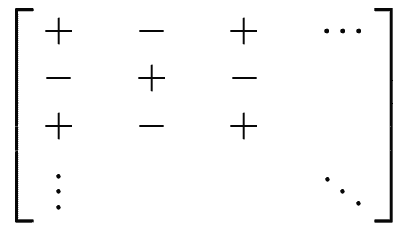
The factor determines the following checkerboard pattern of signs:
Theorem 2 :
If is a triangular matrix, then is the product of the entries on the main diagonal of
Section 3.2 Properties of Determinants
Row Operations
Let be a square matrix
- If a multiple of one row of is added to another row to produce a matrix , then
- If two rows of are interchanged to produce , then
- If one row of is multiplied by to produce , then
- Hence, we get (Important!)
Invertible
If we use this row operations to get a echelon form , If has pivots, then , and is invertible!
Theorem 4 :
A square matrix is invertible iff
Columns
If we change all the rows to columns, all our statement are still all right.
Theorem 5:
If is an matrix, then
Multiplicative Property
Theorem 6:
If and are matrices, then
But this not holds for summation!!! That is
Linear Property
Let , , then , we have:
So is a linear transformation.
A simple proof:
We can compute matrix by a cofactor expansion down the -th column, and all the are not changed, therefore:
So is a linear transformation of .
Section 3.3 The Applications of Determinants
Cramer’s Rule
Let be an invertible matrix. For any in , the unique solution of has entries given by
The Inverse Formula
Let be an invertible matrix, then:
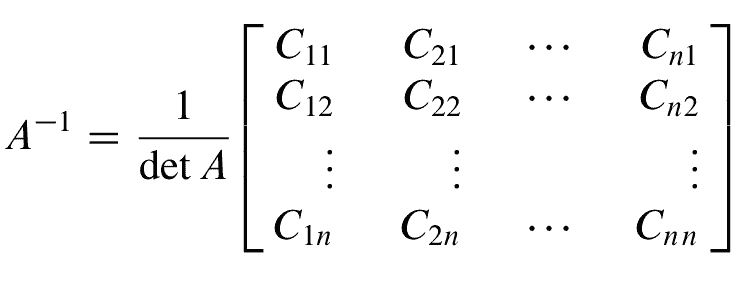
The matrix of cofactors on the right side is called the adjugate (or classical adjoint) of , denoted by . (In fact, it is a transpose of the cofactor matrix)
Determinants as Area or Volume
- If is a matrix, the area of the parallelogram determined by the columns of is . (Note, it is the area of parallelogram, not triangle)
- If is a matrix, the volume of the parallelepiped determined by the columns of is .
Linear Transformations
Let be the linear transformation determined by a matrix . If is a parallelogram in , then
If is determined by a matrix , and if is a parallelepiped in , then