
Honors Calculus I - 1.2 Function
Honors Calculus I - 3 Function
Function
For is a mapping
- domain :
- codomain :
- range : (The definite numbers)
- is the image of
- is the inverse image of
If :
- , that is a surjective
- implies , that is a injective
- bijective : a mapping is both surjective and injective.
Inverse mapping
Where . A mapping is inversible iff it is bijective.
Cancellation Equations :
The inverse function is the reflection of that of the function with respect to the diagonal line
- Composition function : , or
Intervals
- Neighborhood : , where is called the radius
- Interior point of E:
- monotonically increasing / decreasing
- odd / even function
- periodic function
Basic Elementary Function
Power function
For fixed ,
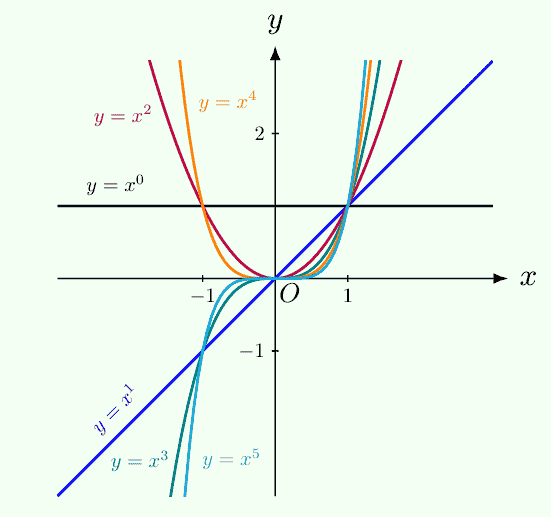
Radical Function
For fixed ,
- When is even, the domain and range are both
- While is odd, the domain and range are
Exponential Function
For ,
- When , is strictly decreasing in its domain; when , is strictly increasing in its domain
- laws of exponents
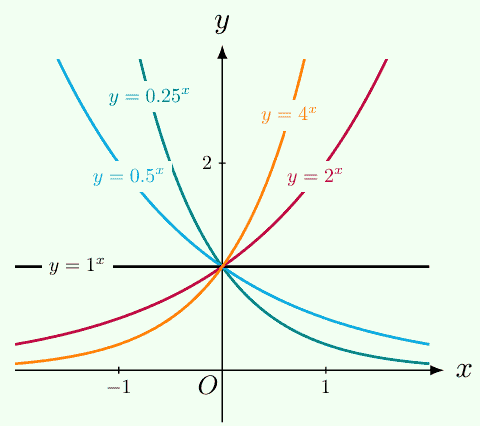
Logarithmic function
- Laws of logarithms
- natural logarithm :
Trigonometric functions
sine function, cosine function and tangent funtion
Two key equalities hold (which almost all basic trigonometric identities can be derived)
- Pythagorean identity :
- Euler’s formula :
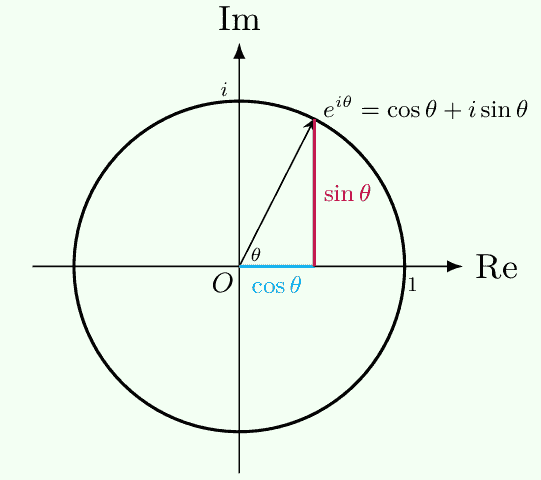
- cotangent:
- secant :
- cosecant :
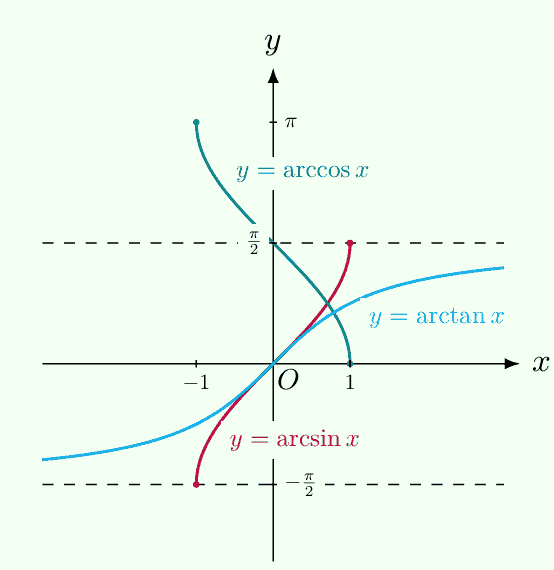
- : where is in and in
- : where is in and in
- : where is in and in
本博客所有文章除特别声明外,均采用 CC BY-NC-SA 4.0 许可协议。转载请注明来源 zhangxixi的博客!