
不完全考虑构造+DP与构造:1107T2
不完全考虑构造+dp与构造:1107T2
本文搬运自本人高中时期CSDN博客,若图片加载不出来,可到原文查看:https://blog.csdn.net/zhangtingxiqwq/article/details/134274865
http://cplusoj.com/d/senior/p/SS231107B
发现reverse操作会对一堆数进行修改,但如果我们只关注其中一些数呢?
假设我们已经构造好 ,我们现在尝试构造 ,我们可操作的范围是在
假设 在 ,我们其实要在一个长为 的序列上把位置 移到位置2,这个东西很dp。于是我们就设 表示长为 ,从 移到2的最小步数。
注意这个dp不一定需要最优的策略,也就是说我们可以贪心决策。我们可以枚举最后一个格子是否被选,或者选多少。然后我们贪心希望 每次往前移。(往后移可能也可行,但我们找的是范围内的最优解,所以不需要)
然后这样子还是会略超,所以我们可以考虑继续完善贪心。我们可以维护从前往后指针 和从后往前指针 ,取最优的取移。
1 |
|
本博客所有文章除特别声明外,均采用 CC BY-NC-SA 4.0 许可协议。转载请注明来源 zhangxixi的博客!
相关推荐
2026-08-18
CF 2000 题目选做
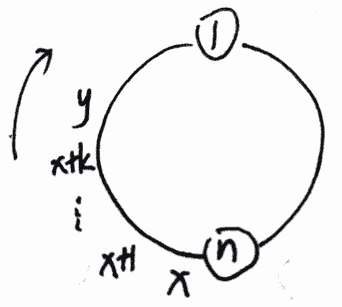
CF 2000 题目选做 2249C 法1 点边容斥 很好的一题。 点边容斥:考虑一个链或一个树的一部分,其连通块个数 = 点数 - 边数 所以我们只需要动态维护当前的每个前缀的点数 - 边数即可。 破环成链,然后我们直接滑动窗口,用线段树维护点数和边数的变化。 法2 纯分类讨论 我们把这个数列连成一个环,我们假设从顺时针方向走。首先,全局有两个特殊点,分别是1号和n号点,它们会把整个数轴区分为两部分,我们现在考虑 n→1n\to 1n→1 这条路径上的点有多少能作为开头。 我们考虑 nnn 后面第一段连续变化的区间: 显然有 x+kx+kx+k 到 x+1x+1x+1 是否可行等...
2026-09-26
近期几道ABC的G题总结(473 - 476 )
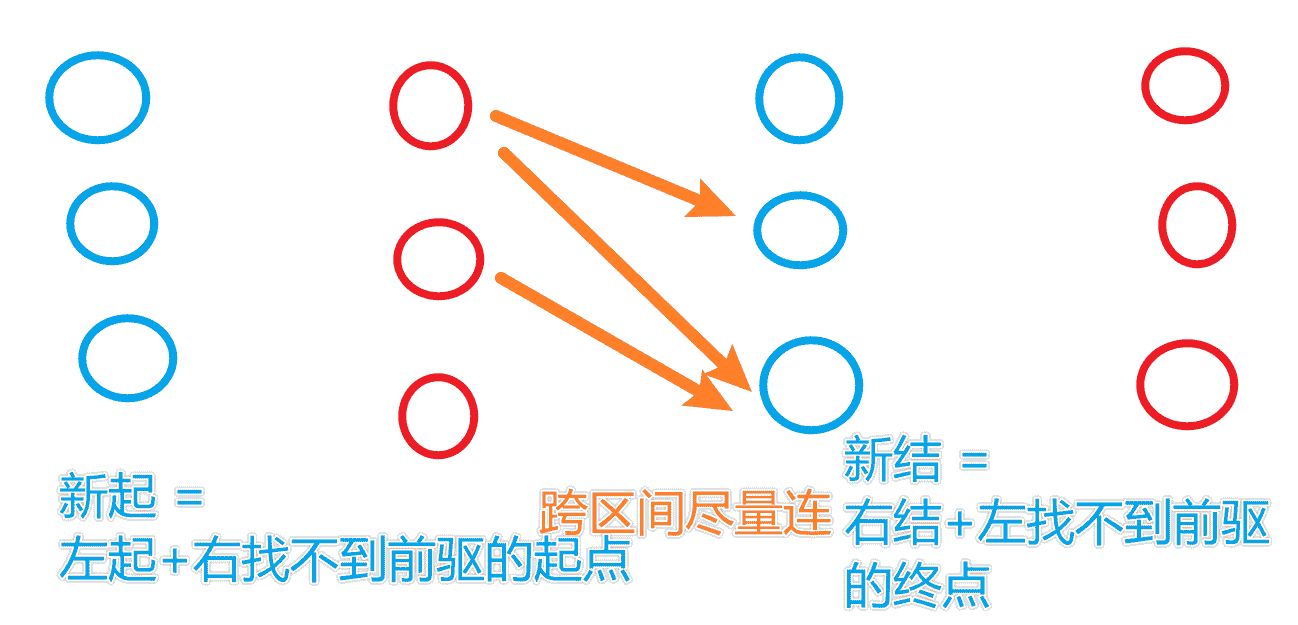
近期几道ABC的G题总结 ABC476G:数位dp + 分治 + 贪心 先从分治的角度考虑两个区间怎么合并 我们考虑对于一个区间,我们如果从合并的角度来说,只关心每个上升子序列开头和结尾1的数量。所以这本质可以用两个数组来存。aia_iai 表示开头popcount为 iii 有多少个子序列,bib_ibi 代表结尾。中间怎么连不重要。 现在考虑两个区间合并。显然从贪心的角度考虑,我们希望用 b1i→a2jb_{1i}\to a_{2j}b1i→a2j 尽可能多 (i<ji<ji<j),那直接暴力贪心匹配即可。 我们现在回到原题,考虑数位dp。f(i,0/1,...

2022-01-14
【P2014 [CTSC1997]选课】题解
本文搬运自本人初中博客园博客,若图片加载不出来,可到原文查看:https://www.cnblogs.com/zhangtingxi/p/15802233.html 题目链接 题目 在大学里每个学生,为了达到一定的学分,必须从很多课程里选择一些课程来学习,在课程里有些课程必须在某些课程之前学习,如高等数学总是在其它课程之前学习。现在有 NNN 门功课,每门课有个学分,每门课有一门或没有直接先修课(若课程 a 是课程 b 的先修课即只有学完了课程 a,才能学习课程 b)。一个学生要从这些课程里选择 MMM 门课程学习,问他能获得的最大学分是多少? 思路 对于没有祖先的,就连向一个虚点,...

2022-01-17
【P1040 [NOIP2003 提高组] 加分二叉树】题解
本文搬运自本人初中博客园博客,若图片加载不出来,可到原文查看:https://www.cnblogs.com/zhangtingxi/p/15813525.html 题目链接 题目 设一个 nnn 个节点的二叉树 tree\text{tree}tree 的中序遍历为(1,2,3,…,n)(1,2,3,\ldots,n)(1,2,3,…,n),其中数字 1,2,3,…,n1,2,3,\ldots,n1,2,3,…,n 为节点编号。每个节点都有一个分数(均为正整数),记第 iii 个节点的分数为 did_idi,tree\text{tree}tree 及它的每个子树都有一个加分,任一棵...

2021-12-07
【HDU 5794 A Simple Chess】题解
本文搬运自本人初中博客园博客,若图片加载不出来,可到原文查看:https://www.cnblogs.com/zhangtingxi/p/15659222.html 题目链接 题目 There is a n×m board, a chess want to go to the position (n,m) from the position (1,1). The chess is able to go to position (x2,y2) from the position (x1,y1), only and if only x1,y1,x2,y2 is satisfied tha...
2021-12-06
【UVA12235 Help Bubu 】题解
本文搬运自本人初中博客园博客,若图片加载不出来,可到原文查看:https://www.cnblogs.com/zhangtingxi/p/15652046.html 题目链接 题目 Bubu’s bookshelf is in a mess! Help him! There are nbooks on his bookshelf. We define the mess value to be the number of segments of consecutive equal-height books. For example, if the book heights are 30...