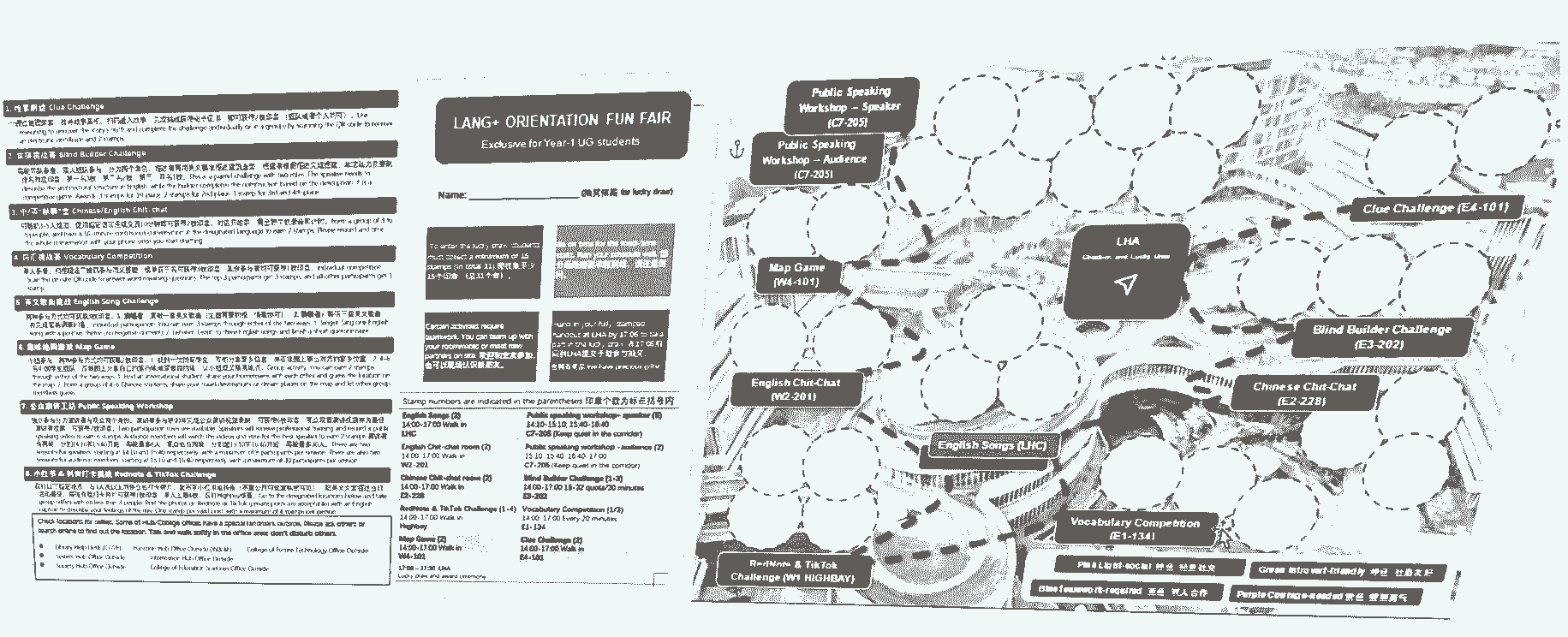
PLE Events
PLE Events
Remark
PLE : Pillar of Language Education
Language can become one of your greatest resources in university.
It opens doors to learning, collaboration, and opportunity.
University does not give you a map – it teaches you how to draw your own.
University does not prepare you for today’s society – it empowers you to shape the future.
The Goal of my journey in university:
academic foundation, a meaningful career, a sense of identity…
Start by a powerfyl tool : communication.
Two Fundamental Forces at uni :
- The Stone of Thought – Your solid expertise. Algorithms, eqations, theories, models. The unshakable foundation of everything you will become.
- The Water of Language – Your soft power. English and Chinese. The fluid medium through which ideas flow, connect, and grow.
English :
- Understand lectures & complex ideas
- Reading and analyzing academic papers
- Writing clear essays and reports
- Delivering powerful presentations and contributing effectively to discussions
Key : A clear structure, a confident opening, and an invatation for others to respond
So the water is :
- Clear : for precise thinking
- AZAbundant : for big ideas
- Energizing : for powerful expression
How to write Email
- Not to memorize rules for email writing
- Use email as a practical situation
- An audience-centered framework for effective
The best channel depends on the situation.
- Audience
- Purpose
- Ugency
To write an email :
- Purpose first
- Relevant context only
- Clear next step
Also:
- Complicated != Profensional
Before Sending, think if the audience know :
- Who is writing ?
- Why are they writing ?
- What do they need from ?
- How should I respond ?
The process:
- Salutation : Dear Prof. X
- Context
- Request / Next Step
- Courteous closing : Thank you for your help
- Identifying information : Best zhangxixi T01
Formula : Subject = What is this about + Request
Expand Vocabulary
6 Types of principles to make your own vocabulary bank :
- contextual words
- secondary-use words
- precision words
- confusing words
- word families
- natural-speech words
Brain learns from Context, Connections
Contextual words : Your own storyline to conclude all the words. Also use AIGC tools to create different scenarios.
Secondary Use :
Example :
- bridge the gap
- scrap the old software
- He chairs the meeting
- I need to table this discussion
- I second the proposal to increase funding.
- She is a new hire so she needs time to settle down.
Precision Words :
Example : (Use more powerful and stronger words)
- show -> demonstrate -> exemplify
- make…longer -> extend -> prolong
- improve -> enhance -> optimize
- say sth. is bad -> criticize -> condemn -> denounce
Confusion Words :
- effect & affect
- compliment & complement
- principle & principal
- historic & historical
Word Families
Natural Speech
Learning Resource
-
English Listening & Speaking Lab : 8 sections, then get a certificate Self-paced (On canvas)
-
Academic communication Essentials
-
Competiton
- 3MT : Three Minute Thesis
- 5MRP
- FLTRP :外研社杯
-
Lang+ Activities : A series of activities | Improve fluency, build confidence, make friends
- Academic English Cafe : create the context to use in academic scenarios
- Board Games
- Table Read : Take the role of a character
- English Chit-Chat