《具体数学》Lesson 2 SUMS | Study Note(1)
Summation factor
To solve this equation :
anTn=bnTn−1+cn
We have to construct sn that satisfied : snbn=sn−1an−1 (1). And in here, sn is the summation factor.
so if we define Sn=snanTn. And when we multiple sn, thus the original expression becomes :
Sn=Sn−1+sncn
This can be solved easily.
Yet how can we find sn ?
From the definiton (1), we know that sn=sn−1⋅bnan−1, therefore :
sn=k⋅bnbn−1⋯b2an−1an−2⋯a1
Harmonic number
Definition :
Hn=k=1∑nk1
The summation of harmonic number :
0≤k<n∑Hk=nHk−n
Proof :
0≤k≤n∑1≤i≤k∑i1=i=1∑nk=i∑n−1i1=i=1∑nin−i=i=1∑n(in−1)=ni=1∑ni1−n=nHn−n
The methods are multiple, any ways you choose can get the answer easily.
In fact, the most interesting feature of this problem is that when we arrange the numbers in a grid :
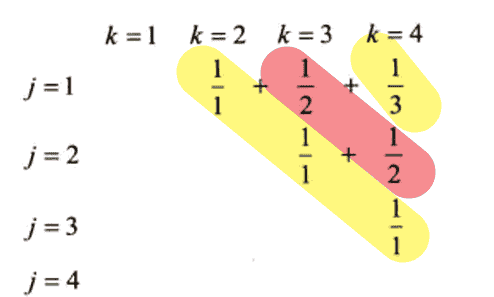
Summing the numbers along rows or columns proves difficult, yet calculating along the diagnonals is straightforward.
Perturbation method
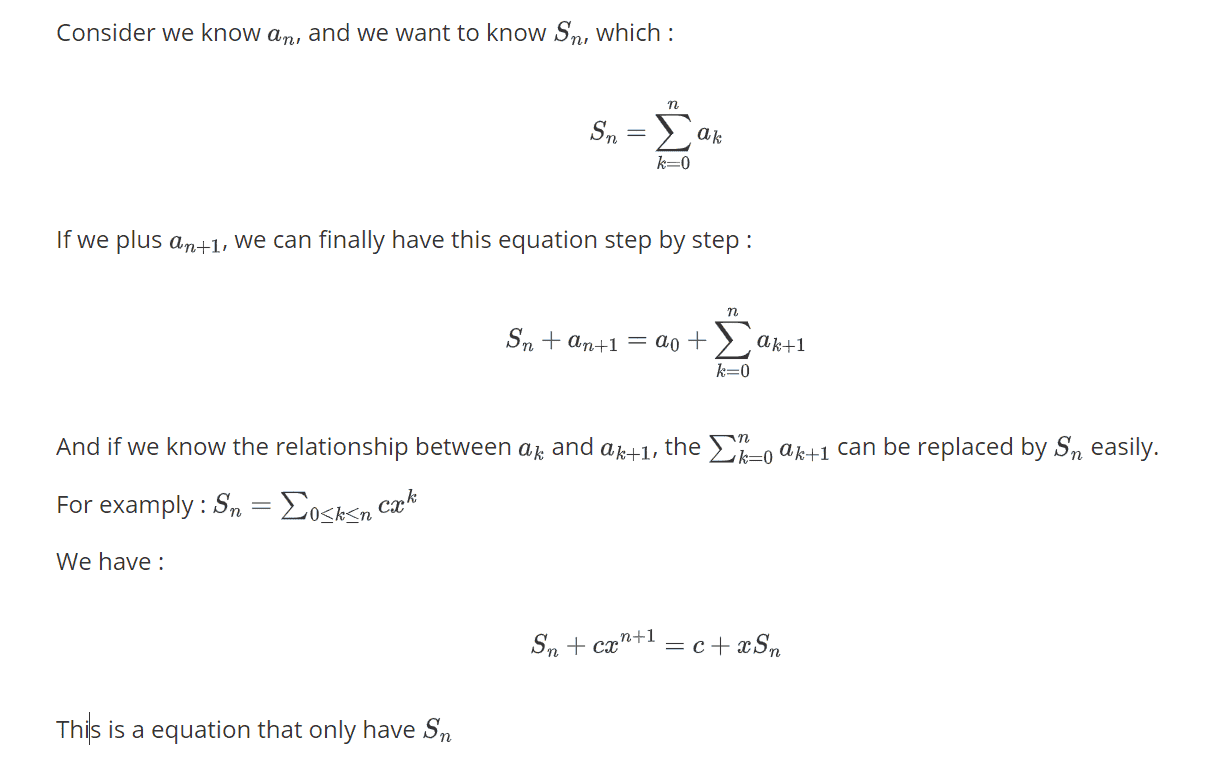
Suppose we are given the sequence term an, and we aim to compute its partial sum Sn, defined as:
Sn=k=0∑nak
Adding an+1 to both sides, we derive the following identity step by step :
Sn+an+1=a0+k=0∑nak+1
If we possess a recurrence relationship linking ak and ak+1, the summation ∑k=0nak+1 may be rewritten directly in terms of Sn.
Take the geometric partial sum as an example : Sn=∑0≤k≤ncxk
We obtain the equation :
Sn+cxn+1=c+xSn
This is a linear equation containing only the unknown Sn
Chebyshev’s monotonic inequality
(k=1∑nak)(k=1∑nbk)=nk=1∑nakbk−1≤j<k≤n∑(ak−aj)(bk−bj)
Therefore, if a1≤⋯≤an, b1≤⋯≤bn,we have:
(k=1∑nak)(k=1∑nbk)≤nk=1∑nakbk
This is called the Chebyshev’s monitonic inequality
But how can we get the first equation ?
Define the sum :
S=1≤j<k≤n∑(ak−aj)(bk−bj)
Swap indices j and k:
S=1≤k<j≤n∑(aj−ak)(bj−bk)=1≤k<j≤n∑(ak−aj)(bk−bj)
Therefore:
2S=1≤j,k≤n∑(aj−ak)(bj−bk)−1≤j=k≤n∑(aj−ak)(bj−bk)
The second term is 0.
The first term is:
1≤j,k≤n∑ajbj
2n1≤k≤n∑akbk−2(k=1∑nak)(k=1∑nbk)
*Draft
This is my first draft of these notes. I used AI to refine it, and I rewrote the whole thing by hand to practice and improve my English.