
Honors Physics I - 3 Momentum and Kinetic Energy
Honors Physics I - 3 Momentum and Kinetic Energy
Center of Mass (com)
The motion of the mass point is simple. And all other points rotate around this point.
For many particles and in higher dimensions :
Usually, the is called the moment
For solid bodies:
Or choose an origin, and then:
If we limit ourselves to uniform density.
Remember when add or remove things, the total mass will be changed
Newton’s Second Law for a System of Particles
Center of mass motion continues unaffected by forces internal to a system.
Because of the Newton’s third law, the internal force push to each internal object can be eliminated, only the external forces will be remained
Kinetic Energy
Energy
- A scalar quantity
- Conserve in a closed system
Kinetic Energy
The unit of kinetic energy is a joule (J)
Work is energy transferred. Transfer to the object is positive work, while transferred from the object is negative work.
For an angle between force and displacement :
Work by Spring Force
- Relaxed state : no force is applied
- Stretch and extend the spring it resists : restoring force
Hooke’s law : , where is the spring constant.
Work by a General Variable Force
Power
Or :
Linear Momentum
Collision and Impulse
Don’t confuse with work, the impulse is integrated by time
If no net external force, the is a constant. This is called the law of conservation of linear momentum.
Momentum and Kinetic Energy in Collisions
- Elastic collisions
- Total kinetic energy is unchanged
- Inelastic collisions : some energy is transferred
- Completely inelastic collisions
- The objects stick together
- Greatest loss of kinetic energy
Elastic Collisions in One Dimension
For a stationary target :
- If , the first object will bounce back
- If , then
Collisions in Two Dimensions
A glancing collision :
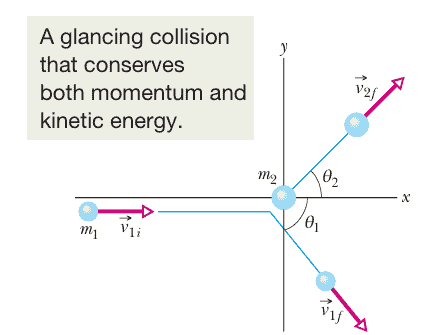
- Along
- Along
- Energy
Sometimes the can be determined by and .
Rocket
The ejection of mass from the rocket’s rear increases the rocket’s speed.
while is the velocity in the inertial reference frame
The first rocket equation :
The second rocket equation :