
Linear Algebra - 3 : Solution Sets of Linear system and Linear Independence
Linear Algebra - 3
Section 1.5 Solution Sets of Linear Systems
Homogeneous Linear Systems :
- Homogeneous if it can be written in
- Such always has at least one solution, called trivial solution
- has a nontrivial solution iff the equation has at least one free variable
Parametric Vector Form :
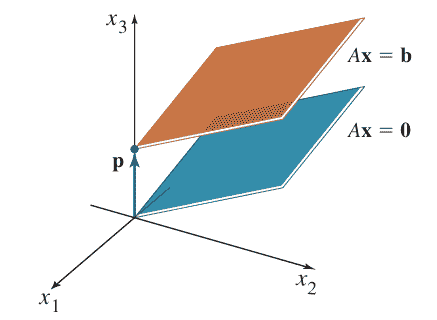
Solutions of Nonhomogeneous System : . Note that itself is just one particular solution.
Theorem : Suppose the equation is consistent for some given , and let be a solution. Then the solution set of is the set of all vectors of the form , where is any solution of the homogeneous equation .
Section 1.7 Linear Independence
Definition of linear independence : the vector equation has only the trivial solution.
Linear dependence relation : , where the weights are not all zero.
Linear Independence of Matrix Columns : iff only have trivial solution.
Sets of One, Two or More Vectors:
- One vector : is linearly independent iff is not the zero vector.
- Two vector : Just by inspection
- More vectors: set is linearly dependent iff at least one vectors in is a linear combination of the others. (Not for every vector)
Theorem : If a set contains more vectors than the entries in each vector, then the set is linearly dependent.
Theorem : If a set contains zero vector, then the set is linearly dependent.